In this guide
Valve publishes the drop rates, which means the cost of a knife is a calculation rather than a feeling.
Counter-Strike 2 is unusual among games with loot boxes: Valve publishes the drop rates. That means the question "what does a knife actually cost" has an answer you can work out with a calculator rather than a feeling, and the answer is worth knowing before you open anything.
The odds are published
Every standard weapon case in CS2 uses the same tier probabilities, and they are the same across the CS2 case database regardless of which case you open:
- Mil-Spec (blue): 79.92%
- Restricted (purple): 15.98%
- Classified (pink): 3.20%
- Covert (red): 0.64%
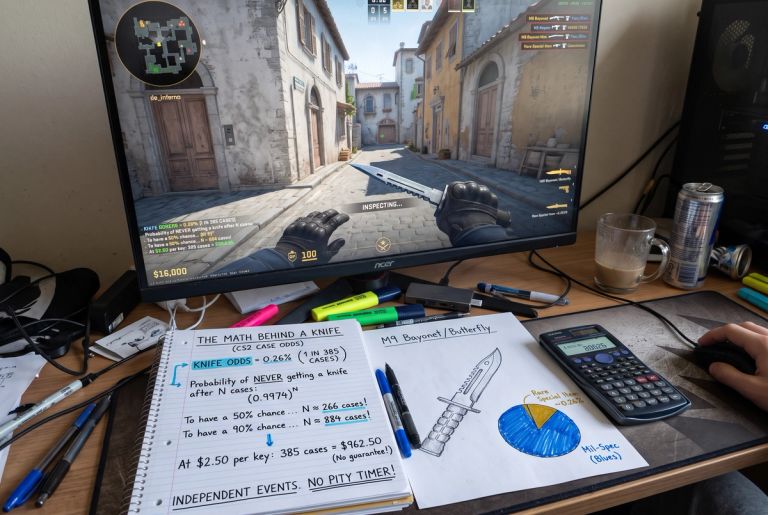
- Rare special item — a knife or gloves: 0.26%
That last line is the one everyone is opening for. 0.26% is roughly one in 385.
What one in 385 actually means
The common mistake is to read "one in 385" as "I will get one within 385 openings". Each opening is independent, so the correct calculation is the chance of failing every time.
Open 100 cases and your chance of seeing no rare special item is about 77%. Open 385 — the "expected" number — and it is still about 37%. You need roughly 266 openings to reach a coin-flip chance, and around 1,770 to be 99% likely.
At a $2.49 key plus the case price, 385 openings is comfortably over a thousand dollars for a knife you have a 63% chance of having seen by then. The distribution is not the average.
Recovery, not profit
The more useful number than odds is recovery: the average value of what a case returns, divided by what it costs to open. Every case in CS2 is a long-term loss, so the honest framing is not which case is profitable but which loses you the least.
The spread is wider than most players assume. Chroma 3 sits at the top of the ROI table at about 80% recovery — roughly $4.38 of expected return against $5.48 to open. Chroma 2 is 78%, Chroma 73%, Gamma 67%. Toward the middle of the table, Fever sits at 50% and Dreams & Nightmares at 53%.
Two things drive that. The first is the knife and glove pool: Chroma cases carry an average special-item value above $1,100, which is what props up the expected return despite the same 0.26% chance. The second is the case price itself, which is set by the market rather than by Valve — a case that costs $0.52 and one that costs $13.89 both need the same $2.49 key, and that fixed cost dominates cheap cases.
Why the expensive cases are not better value
The eSports 2013 Winter Case costs about $13.89 to open and recovers roughly 51%. Fever costs $0.52 and recovers about 50%. The difference in outlay is twenty-seven fold; the difference in recovery is one percentage point.
That is the clearest demonstration that scarcity in the case market is priced in. Discontinued cases cost more because there are fewer of them, not because they pay out better, and the recovery percentage is the number that tells you so.
The two prices you are ignoring
Every calculation above uses market value for the items coming out. There are two costs that quietly reduce it.
Steam's marketplace takes a fee on every sale, so the price you see on an item is not the price you receive for it. And most of what comes out of a case is Mil-Spec — nearly four openings in five — where the item is frequently worth less than the key you spent.
Float matters too. The same skin can be worth a multiple of another identical skin depending on its wear value, and expected-return figures are averages across that distribution. An individual pull is very unlikely to be the average.
What the arithmetic is actually good for
None of this is an argument that opening cases is irrational. People buy them for the moment of opening, and there is nothing wrong with paying for that as long as it is what you think you are paying for.
The arithmetic is useful for a narrower purpose: distinguishing entertainment spending from investment. If you want a specific knife, buying it outright is cheaper than the expected cost of pulling it, in every case, by a wide margin. If you want the experience of opening, the recovery table tells you which cases give you the most item value per dollar while you have it.
The one genuinely bad decision is opening cases believing you are ahead. At a ceiling of about 80% recovery on the best case in the game, and roughly half that on many others, the long-run outcome is not in question.
Checking any of this yourself
The tier odds are published by Valve and are the same for every standard weapon case, so any site quoting different numbers for a specific case is wrong. Case prices and item values move constantly, so recovery figures are a snapshot: the numbers above reflect the market at the time of writing and will drift.
What should not drift is the method. Cost per open is case price plus $2.49. Expected return is the sum of every possible outcome multiplied by its probability. Recovery is the second divided by the first. Any case-opening claim you read can be checked against those three lines, and most cannot survive it.
A note on the 42 cases
There are 42 weapon cases in CS2 holding 662 unboxable skins between them, released between 2013 and 2026, and individual items in that pool run from a few cents to over three thousand dollars. That range is why averages behave badly here: a single item at the top of the pool can carry the expected return for an entire case, and almost nobody who opens that case will ever see it.
It is also why "which case should I open" is a different question from "which case has the best skins". The first has an arithmetic answer. The second is taste, and taste is the only reason worth opening one.