


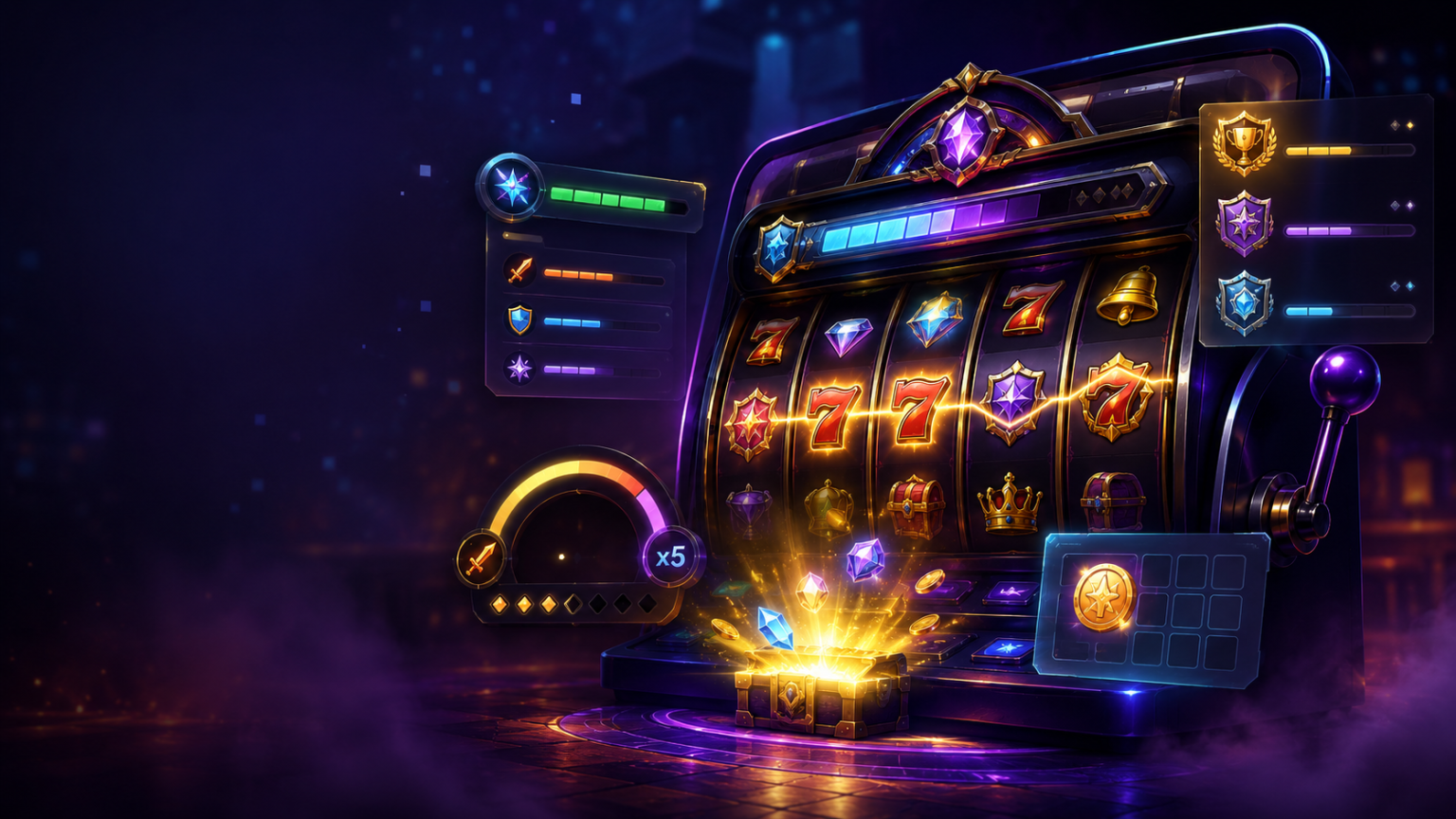

Load up a modern online slot and count how many elements look familiar from video games.
Progress meters. Collection features. Expanding boards. Cascading symbols. Operators then add another layer around the games through missions, tournaments, leaderboards and tiered loyalty systems.
The fruit machine your grandad fed 10p coins into has gradually been surrounded by the interface and retention systems of a live-service game. The change happened slowly enough that many people barely noticed it.
From three reels to thousands of ways
The classic mechanical slot commonly used three reels, a single central payline and a limited set of symbols printed on physical reel strips.
Horseshoes, bells and fruit became familiar partly because the design space was restricted by the hardware.
Video slots gradually detached the visible reels from that mechanical structure. Developers could add more reels, more paylines, animated symbols and separate bonus screens without rebuilding a physical cabinet around each concept.
The larger shift came later, when designers stopped asking only what a slot machine should look like and began borrowing ideas from the wider games industry.
One of the clearest examples is Megaways, developed by Big Time Gaming and later licensed to numerous other studios.
On each spin, the reels can display different numbers of symbols. That changes both the grid configuration and the number of active ways to win. Depending on the title, a spin may offer thousands, tens of thousands or more than 100,000 possible combinations.
The visual layout can therefore change repeatedly even though the game remains governed by a predefined mathematical model.
Big Time Gaming later developed Infinity Reels. In these games, qualifying wins can expand the grid by adding further reels, often while increasing a multiplier.
The expanding sequence can resemble the escalating structure of a roguelike run. The important difference is that the player does not control how the run develops. The expansion is driven by chance rather than strategic decisions.
The mechanics look familiar for a reason
Cascading reels are one of the most obvious points of contact between slots and video games.
Winning symbols disappear and new ones fall into the empty spaces, potentially creating another win without requiring an entirely separate visual sequence.
The effect feels familiar from match-three games such as Candy Crush. Both genres use the same broad visual idea: matched objects disappear and replacements drop into the space.
The history is not a simple case of slots copying one particular mobile game. NetEnt’s original Gonzo’s Quest used its Avalanche mechanic in 2010, before Candy Crush Saga launched.
The lineage is better understood as shared design language that has moved between puzzle games, arcade systems and slots.
Modern titles add visible progression to that language.
Reactoonz by Play’n GO uses a Quantum Meter that fills when winning symbols are collected during a sequence of cascades. Reaching different thresholds activates features, giving an individual spin sequence a clear sense of build-up.
Yggdrasil’s Valley of the Gods 2 uses an expanding grid and scarab meters that build toward effects such as extra lives and multipliers.
Gonzo’s Quest Megaways reworks the avalanche concept made famous by NetEnt’s original game within a variable Megaways layout, combining repeated symbol drops with escalating multipliers.
These systems make each sequence feel as though it is moving toward something, even when the movement is still controlled by random outcomes.
The live-service layer
The individual games are only part of the picture.
Operators add daily missions, tournament rankings, loyalty tiers and limited-time promotions around their catalogues. The surrounding interface can look remarkably similar to a modern live-service title.
Log in. Complete a task. Earn points. Move up a ranking. Return tomorrow for another promotion.
That does not make a casino platform identical to an online video game. Live-service games often contain long-term character development, strategic choices and content updates that change how the game is played.
But the methods used to encourage repeat visits can be strikingly similar.
Both present progress through meters, levels, notifications and short-term goals. The difference lies in what that progress represents and how much control the player has over it.
Progression without mastery
In many video games, progression is at least partly connected to decisions, performance or accumulated effort.
Players learn patterns. They improve their timing. They choose a stronger build or discover a better strategy. Progress feels satisfying because their input has helped create it.
Slots reproduce the language of progression while replacing mastery with chance-driven state changes.
A meter may fill. A multiplier may rise. The board may expand. These are genuine changes to the current game state, not merely animations.
What the player normally did not do was produce them through better execution.
The meter responds to events generated during the spin, but it does not fill because the player demonstrated skill. It visualises random progress rather than mastery.
Outcomes in conventional online slots are generated through an RNG and interpreted by a predefined mathematical model. That model can include separate conditions for the base game, bonus rounds and persistent features.
Attention and persistence do not make the random outcomes more favourable. Playing longer does not teach the reels to reward you.
Some games allow choices between stakes or feature configurations, but these decisions generally change the level of risk rather than creating a repeatable path to beating the game.
The illusion of choice
Bonus rounds often make this distinction harder to notice.
A screen might present three chests and ask the player to choose one. The interaction feels meaningful because the player physically selects the object that reveals the prize.
The technical reality varies between games.
In some bonuses, the total award or the placement of prizes may already have been determined before the selection appears. In others, the RNG resolves the prize when the player makes the choice.
Either way, the player is usually choosing among chance-based outcomes rather than applying a skill that improves the expected result.
The choice is not necessarily fake. It is simply different from the agency offered by a strategy game, where knowledge and execution can reliably produce better outcomes.
That is the honest distinction worth preserving.
Slots have adopted the grammar of skill-based games while generally remaining games of chance.
When people search for the best slot games to play online, they are mainly comparing presentation, theme, feature structure, volatility, betting limits and RTP—not which title rewards better execution.
In a conventional RNG slot, there is normally no repeatable playing skill that improves the expected outcome.
The Starburst counterargument
More mechanics do not automatically create a better game.
Starburst remains one of the best-known and most widely distributed online slots. It is almost aggressively simple.
There are no cascades, no collection meter and no narrative progression. The central feature consists of expanding wild symbols that can trigger respins.
Its low-to-medium volatility and clean presentation have helped it remain visible while many more elaborate titles have disappeared from operator catalogues.
There is a broader design lesson here.
Feature bloat is not the same thing as depth. A game can contain six systems and still feel less coherent than one built around a single strong idea.
Video games rediscover that lesson repeatedly. Slots are no different.
Borrowing goes both ways
Megaways was a significant commercial and mechanical innovation in online slot design, not merely a new theme placed over old reels.
The broader exchange between gambling and video games is not entirely one-way.
Video games have also borrowed from gambling through loot boxes, roulette-style rewards, randomised item drops and jackpot presentation.
Modern slots, however, have absorbed a particularly large amount of video gaming’s progression language.
They use expanding maps, collection meters, escalating multipliers and achievement-style notifications to make random events feel like a developing journey.
Progression and agency can exist in these games, but they are usually governed by chance. Mastery rarely improves the expected return.
That is the line worth noticing.
Recognising a reward loop for what it is does not necessarily spoil the entertainment. It means understanding what the design is asking you to feel and what control you actually possess.
