By

In this guide
- Product vs. ongoing service
- Virtual goods: licensed, not owned (and why that matters)
- Subscriptions and auto-renewals: your calendar is part of the contract
- Servers, downtime, and sunset plans
- Enforcement and appeals: not just “don’t cheat”
- Data and personalization: matchmaking to monetization
- UGC, creators, and “who owns what”
- Platform rules can outrank publisher rules
- What to actually read before you accept
- The expert’s bottom line
If you grew up buying a disc or a single download and playing it for years, the live-service era probably feels like a different hobby. You’re not just buying a game now—you’re entering a relationship: seasons roll over, prices shift, drop rates get tuned, and entire modes appear or disappear. The first place that reality shows up is in the Terms & Conditions you click past at 2 a.m.
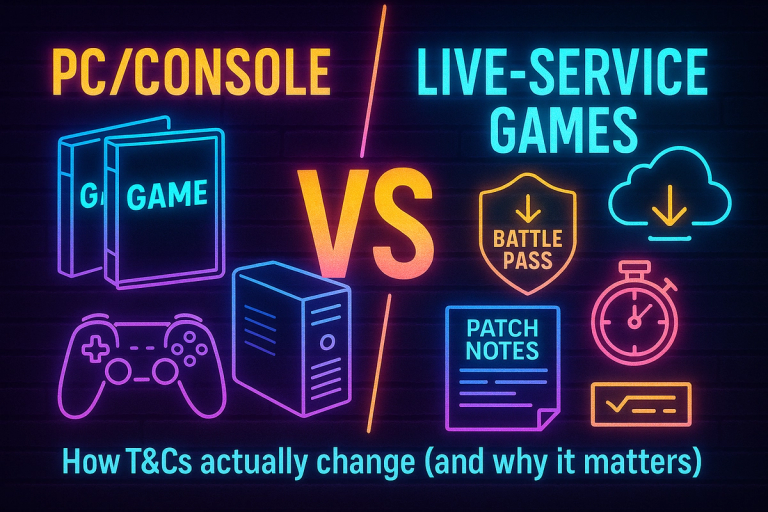
Here’s a plain-English, expert take on what really changes between a classic PC/console title and a live-service game—and what to scan before you press “Accept.”
Product vs. ongoing service
A traditional PC/console release is mostly a one-time license. The publisher promises the software will run, maybe patches it a few times, and that’s the deal. The T&Cs cover the basics: IP ownership (it’s theirs), anti-cheat, and a liability cap if things break.
A live-service title is different by design. The contract assumes constant change: balance updates, economy tweaks, new passes, new cosmetics, new limits. That’s why the T&Cs feel longer and, frankly, more defensive. The studio needs legal room to rebalance a weapon, vault an item set, or retire a playlist without owing refunds for every nudge.
“Treat a boxed game like a product. Treat a live-service game like a contract that evolves with the meta,” says Elena V., a games compliance consultant I trust. “If you invest real time or money, read the clauses that let the developer change the rules mid-season.”
Virtual goods: licensed, not owned (and why that matters)
Live-service T&Cs go out of their way to tell you that coins, skins, boosters, and battle passes are licensed features with no cash value. That’s not a word game; it’s the legal backbone that allows the team to remove duped currency, reverse suspicious trades, or alter economy math without “taking your property.”
It’s also where chance-based mechanics enter the chat. If you’re dealing with loot boxes or gacha-style events, train the same muscles you’d use for bonus terms in gambling-adjacent spaces. A quick primer on how to understand and beat wagering requirements will save you from chasing impossible rollovers—and it maps neatly to reading event rules, drop-rate disclosures, and expiration dates in games. Look for plain statements of odds, time limits, and what happens to unspent currency at season’s end.
Subscriptions and auto-renewals: your calendar is part of the contract
Battle passes and premium tiers often auto-renew. Good T&Cs (and good UI) will tell you:
- when renewal happens,
- how to cancel,
- and whether partial refunds exist in your region.
Platform rules influence this more than you’d think. On mobile, for example, stores enforce disclosure and cancellation flows at the OS level. If you’ve ever wondered why the cancellation button lives in your device settings, it’s because platforms impose that standard (Apple documents it in the App Store Review Guidelines, and developers must comply).
Servers, downtime, and sunset plans
Live-service games live or die on servers. Most T&Cs disclaim guaranteed uptime and cap your remedy at in-game perks—if that. That’s not sinister; it’s a reality check that the internet breaks and launches melt servers. What you can look for is a sunset clause: if the lights go out, do you get an offline mode, migration perks to a sequel, or at least a notice period? Traditional single-player titles rarely need this paragraph; live-service games do.
“Live service games require special contracts for ongoing content and player expectations. Differences between subscription and one-time purchase models affect legal obligations and duties.” — RA Marian Härtel, ITMediaLaw (Apr 13, 2025).
Enforcement and appeals: not just “don’t cheat”
Old-school T&Cs usually say “no cheats, no piracy.” Live-service T&Cs read like an ops manual: what tools are banned, how toxicity is handled, how detections work, and whether there’s an appeals process. The practical test is transparency. Do you see consistent strike tiers? Time-bound penalties? A published path to review a false positive? If all you get is “we can ban anyone for any reason,” proceed with caution—especially if you’ve spent heavily.
Data and personalization: matchmaking to monetization
Live services run on telemetry. Expect disclosures about device IDs, session stats, crash logs, and purchase behavior used for matchmaking, economy health, and A/B tests. If privacy matters to you, skim the linked policy for retention windows and deletion rights (UK GDPR/EU GDPR/CCPA have teeth here). It’s not the amount of data that’s different—it’s the cadence: the data steers the ship daily.
UGC, creators, and “who owns what”
Whether you’re uploading a map, sharing a shader, or streaming a preview, you’ll grant the platform a broad license to host and promote your work. That’s normal. What you want to confirm is that you retain copyright to original creations and that the license doesn’t let the platform sell your asset pack outside the ecosystem. Creator programs often add NDAs, embargo times, and music limits that affect VODs—read those with the same care.
| T&C Dimension | PC/Console (traditional) | Live-Service |
|---|---|---|
| License model | One-time software license; limited updates/DLC | Ongoing service license that can change over time (seasons, patches) |
| Core dependency | Runs locally; online optional for many titles | Server-dependent; gameplay tied to uptime and live ops |
| Virtual goods | Occasional DLC/skins; ownership rarely central | Items/currency licensed (no cash value); may be modified or removed |
| Billing | One-off purchase; optional DLC | Subscriptions/battle passes; auto-renewal common |
| Uptime & availability | Less emphasized; offline play typical | No guaranteed uptime; compensation (if any) is limited |
| Balance & content changes | Infrequent and smaller in scope | Frequent rebalances; content can be vaulted or sunset |
| Enforcement | Basic anti-cheat; fewer live rules | Detailed code of conduct, anti-cheat systems, and appeals process |
| Data & telemetry | Basic analytics and crash logs | Continuous telemetry for matchmaking, economy health, A/B tests |
| UGC & creator terms | Simpler licenses; fewer platform programs | Broader UGC licenses; creator/partner terms and embargo rules |
| Sunset plan | Not usually critical | Important: explains what happens if servers close |
| Platform influence | Publisher terms dominate | Store/platform policies (refunds/cancel) can override publisher terms |
| What to scan first | License scope, warranty, DLC terms | Auto-renewal, virtual-goods license, enforcement/appeals, sunset clause |
Platform rules can outrank publisher rules
On PC/console, the publisher’s T&Cs tend to rule the day—until billing or refunds show up. Then platform policy (Steam, Xbox, PlayStation, iOS, Android) can decide what’s possible. That’s why a cancellation might be easy on one device and torturous on another. If you want a neutral yardstick, platform documentation later in most developer guides spells out minimums for disclosure and cancellations (for instance, Apple’s App Store Review Guidelines make recurring billing standards explicit and enforceable at review time).
What to actually read before you accept
I know you won’t read every line. Read the renewal paragraph, the ownership vs. license paragraph, the economy changes paragraph, the enforcement/appeals paragraph, and the sunset paragraph. If those five look fair, you’re probably fine.
If you’d rather start with great games and work backward, finding the best games to play is a solid way to spend your next weekend.
The expert’s bottom line
Traditional T&Cs describe a static product; live-service T&Cs govern a living platform. That living platform needs wiggle room—to patch, to rebalance, to fight fraud—but it also owes you clarity. You don’t need a law degree; you just need habits:
- Check renewals and cancellations before you buy.
- Assume virtual items are licensed and can change.
- Look for an appeals path before you invest real time or money.
- Glance at the sunset plan so you’re not surprised later.
Do that, and you’ll spend less time arguing with fine print—and more time actually playing.

Written by
Jessica ThompsonAs a dedicated gaming journalist with over five years of experience, I've immersed myself in the ever-evolving world of video games. Currently, I contribute to Gamerbolt.com and PS6news.com, where I cover the latest in gaming news, in-depth game reviews, and industry trends. At Gamerbolt.com, I've had the privilege of shaping content strategies, writing comprehensive articles, and engaging with a passionate community of gamers. My role involves not only crafting engaging narratives but also staying ahead of the curve with the latest gaming innovations and upcoming titles.