

 By
In this guide
Some of the best hours in open-world games happen nowhere near a quest marker. You walk into a casino on the Strip in Fallout: New Vegas meaning to sell some loot, sit down at a blackjack table, and surface an hour later with a pile of chips and a floor manager asking you to take your luck somewhere else. Card tables have been a dependable side attraction for developers because everyone already knows the goal, so the game can skip the tutorial and go straight to the tension of the next card.
What makes these tables interesting is how differently each studio handles the rules. Some recreate real casino conditions closely enough that the strategy carries over, while others bend the game to fit their world, whether that means a character stat tilting the deck or a fruit-themed card that busts the dealer outright. Looking at those choices side by side says a lot about how each game wants you to play.
It also explains why players who start out with in-game chips often get curious about how many rule sets exist beyond them. Real tables come in variants that video games rarely touch, including Spanish 21, surrender and multi-hand formats, and the blackjack sites ranked by BetaNews show how those versions, table limits and live dealer options compare for adult players in Australia. For everyone else, the in-game versions are still the cheapest place to learn why the small print on a blackjack table matters so much.
Fallout: New Vegas plays it closest to the real thing
Obsidian's take is the most detailed blackjack in a mainstream RPG. Six casinos run tables: the Atomic Wrangler in Freeside, Gomorrah, The Tops and the Ultra-Luxe on the Strip, Vikki and Vance in Primm, and the Sierra Madre from the Dead Money expansion. Bets range from 1 to 200 chips, and the house rules shift from venue to venue in ways a real player would recognize. Most dealers stand on all 17s, while Gomorrah's dealers hit a soft 17. A natural blackjack pays 3 to 2 everywhere except the Atomic Wrangler, which pays 6 to 5, a fitting detail for Freeside's scruffiest bar.
You can double down on any starting hand, but splits only work on cards of identical value and only into two hands, and neither insurance nor surrender is on the menu. The dealer also shuffles after every hand, which ends any thought of counting cards before it starts.
Then there's Luck. With the stat at 6 or lower, the house keeps an edge of roughly one percent. Push it to 10 and the odds swing your way, to the point where the game tells you you're feeling lucky. Win enough and the casinos notice. At The Tops, the floor manager hands out rewards as your winnings pass 2,500, 5,000 and 7,500 chips, and once you've taken 10,000 he bans you from the tables.
Red Dead Redemption 2 keeps it simple
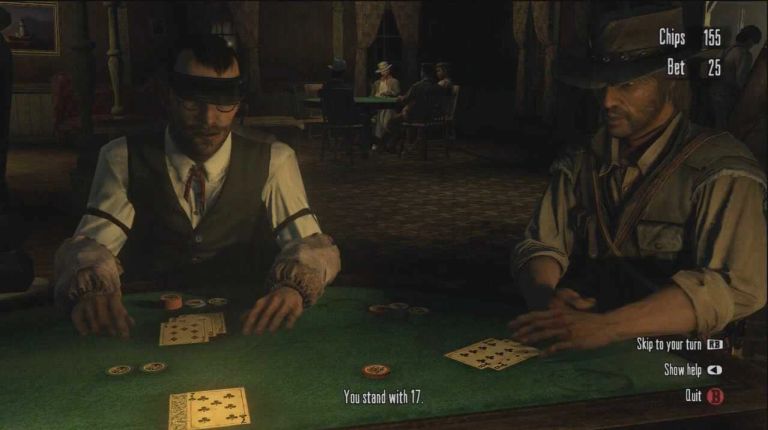
Rockstar's western goes the other way. Blackjack in RDR2 is a slice of frontier life rather than a system to master, played in Rhodes and, during some chapters, at the gang's camp. It's a plain hit-or-stay contest against the dealer, with aces counting as 1 or 11 and face cards as 10, and the full rules live in the in-game help menu under activities. Completionists can't skip it either, since playing every table game is part of the run to 100 percent.
The appeal here is atmosphere: the chatter around the table, the lamplight, and the knowledge that the money in Arthur's pocket could vanish on a bad run. Details like that are a big part of why RDR2 still sits at the top of GamerBolt's ranking of the best Rockstar games years after release.
Stardew Valley rewrites the rules with Calico Jack
ConcernedApe's farming sim takes blackjack and gives it a twist of its own. Calico Jack is played in the casino with Qi coins, and the target is still 21, with an exact 21 winning on the spot. The dealer keeps the first card hidden until you stand, then keeps drawing until it busts or holds at least 18 while matching or beating your total. According to the Stardew Valley Wiki, there are two tables, one taking 100 Qi coins a hand and a high-stakes table taking 1,000.
Two extra rules change the feel completely. If the dealer draws a Qi Fruit card, the dealer busts and your bet is tripled rather than doubled. After any win you can also go double or nothing, as many times as you like, until you lose or walk away. That second rule is Stardew's lesson in risk, because the longer you ride a streak, the more you have resting on one hand.
Three tables side by side
Laid out together, the differences in design are easy to spot:
| Fallout: New Vegas | Red Dead Redemption 2 | Stardew Valley | |
|---|---|---|---|
| Where you play | Six casinos, from Freeside to the Sierra Madre | Rhodes, plus the gang's camp in some chapters | The casino, with Qi coins at 100 or 1,000 a hand |
| Decisions on offer | Hit, stand, double on any starting hand, split identical pairs once | Hit or stay | Hit or stand, then double or nothing after a win |
| The twist | Your Luck stat shifts the odds, and big winners get banned | Counts toward 100 percent completion | A Qi Fruit card busts the dealer and triples the payout |
What in-game tables teach about the real game
The games that feel most like real blackjack are the ones that sweat the house rules: how the dealer handles a soft 17, what a natural pays, and when you're allowed to double or split. New Vegas gets those details right, which is why players who learned there tend to notice the same differences elsewhere. A 6 to 5 payout and a dealer who hits soft 17 both shift the edge toward the house, and Obsidian put each of them in a different casino for you to stumble into.
The other lesson is about stakes. Chips in a game cost nothing outside it, and a ban from The Tops only sends you across the Strip to another casino. Real money doesn't come back when you reload a save, so anyone moving from virtual tables to real ones should set a firm limit first and check that online play is legal where they live.

Written by
Jessica ThompsonAs a dedicated gaming journalist with over five years of experience, I've immersed myself in the ever-evolving world of video games. Currently, I contribute to Gamerbolt.com and PS6news.com, where I cover the latest in gaming news, in-depth game reviews, and industry trends. At Gamerbolt.com, I've had the privilege of shaping content strategies, writing comprehensive articles, and engaging with a passionate community of gamers. My role involves not only crafting engaging narratives but also staying ahead of the curve with the latest gaming innovations and upcoming titles.