


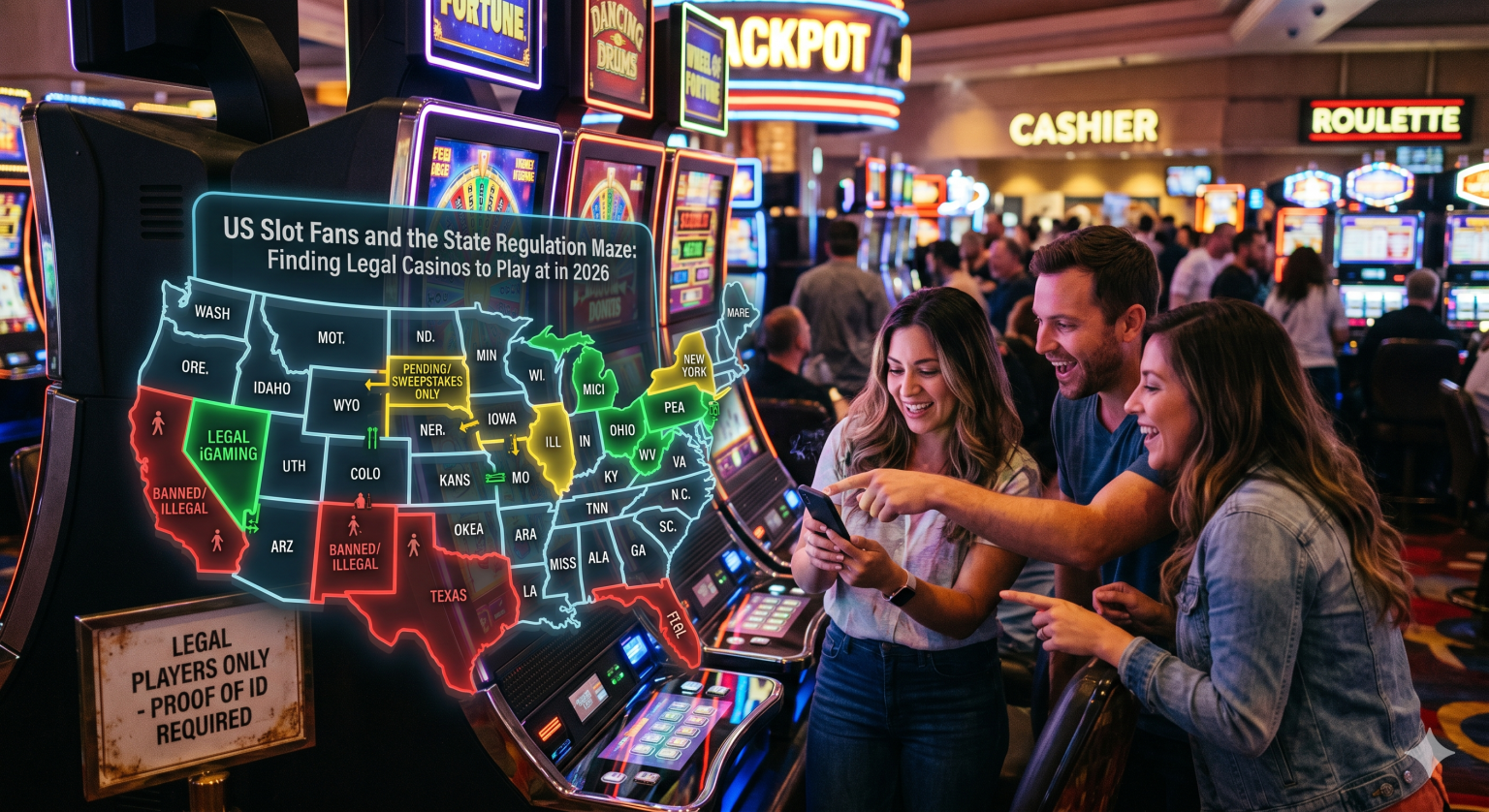

Ask twenty Americans where they can legally play an online slot in 2026 and you will get twenty different answers, most of them at least partly wrong. The map looks simple from the outside, a country with fifty states and a federal government, but the truth is more like a patchwork quilt that has been resewn every few months for the past decade. Someone in Atlantic City has been able to spin a real money reel on a phone since 2013. Someone the same age in Atlanta cannot, even though Georgia and New Jersey share the same TV networks, the same payment apps, and the same broad culture around evening entertainment. The reason is not technology. The reason is a long, slow, intensely state-by-state legal process that has produced one of the strangest entertainment markets in the country.
Most slot players, especially those who grew up around 1990s and 2000s arcades, treat the question as a kind of geographic trivia. They know that crossing the Hudson into New Jersey opens up apps that do not work in Manhattan. They know that a flight to Vegas unlocks a different physical world entirely. What is harder to pin down is the in-between, the sites that look real, the brands that feel familiar, the sweepstakes platforms that wander into the gray. For a 2026 reader who simply wants to spin a few reels with confidence and without legal worry, the practical question is not which state has glamour. It is which state has clearly written rules, audited operators, and a working complaints process that actually answers the phone.
For readers willing to do thirty minutes of homework, the easiest first step is a directory that already filters operators by state and verifies licensing month by month. Rather than chasing TikTok screenshots or affiliate landing pages, a curated list of legal casinos to play at in each US state gives a much faster read on which operators are live, which are still in soft launch, and which are not licensed in your zip code at all. The rest of this piece looks at how the state map actually behaves in 2026, how the gaming hardware crowd reads similar fragmentation in the console market, and why the two stories are surprisingly closer than they appear.
Why the United States ended up with fifty different rulebooks
Online slot regulation in the United States is a state matter. That is the whole story compressed into a single sentence, and almost every confusion downstream comes from it. The federal government decided in 2018 that sports betting was a state question, and most legal observers extended the same reasoning to interactive casino products. Since then, each legislature has had to write its own bill, hold its own hearings, design its own consumer protection language, and either defeat or pass the result. New Jersey did this first, in 2013, and built an audited market with multi-operator participation. Pennsylvania followed in 2019, Michigan in 2021, Connecticut in 2021, West Virginia in 2020, Delaware as a small pioneer in 2013, Rhode Island in 2024, and Maine in 2025. That is eight states in roughly twelve years. Forty-two states have not crossed the line, sometimes for tribal compact reasons, sometimes for political reasons, sometimes simply because the bill kept dying in committee. The result is the patchwork that defines the 2026 picture.
How a typical 2026 launch actually works inside one state
When a state goes live, the launch follows a recognizable choreography. Operators submit applications months ahead of time, with audited financials and software documentation. A short list of brands earns conditional approval, geofencing technology gets stress tested at the state border, and a soft launch period opens with limited deposits. Then the doors swing open. In Pennsylvania the first operators were familiar names, BetMGM through its Borgata partnership, FanDuel, DraftKings, BetRivers via Rush Street Interactive, and later Caesars and Hard Rock Bet. Michigan ran a similar choreography in 2021, opening with about fifteen operator skins and quickly settling into a stable group dominated by FanDuel, DraftKings, and BetMGM. The Maine and Rhode Island launches in 2024 and 2025 followed the same template at smaller scale. From the player’s perspective the experience is identical from state to state once a market is mature, the differences live in deposit limits, available payment methods, and the granularity of responsible gaming features.
What slot fans actually feel inside the legal patchwork
The lived experience of a 2026 slot player is more practical than political. A Detroit resident opens a familiar app and plays. A neighbor across the Ohio line opens the same app and gets a polite geofence error. The same person on a layover in Newark suddenly has full access. Phones move faster than legislation, and that mismatch produces a steady stream of small frustrations. Players also notice that audited slot RTP figures hover around ninety four to ninety eight percent in legal markets, posted publicly by the operators, while the offshore alternatives publish nothing of the sort. Twenty one is the standard age across all eight live states, identity verification runs through bank-style processes, and self exclusion lists are honored across operators inside a state. The real maze is therefore not the gameplay, which feels broadly similar everywhere, but the layer of state-specific paperwork that determines whether the gameplay even loads on your screen tonight.

Photo by Renee Daniels
How the gaming hardware crowd reads the same kind of patchwork
Slot fans are not the only American gamers used to fragmentation. Anyone who has shopped for a current console or a gaming PC in 2026 knows that the hardware market has its own version of the maze, with handhelds locked to specific app stores, GPUs delayed by memory shortages, and feature sets that vary by region. A practical reader-friendly look at next-gen PC gaming hardware standards on a community gaming site shows how complicated even a simple buying decision has become, with display sync, frame pacing, and storage tiers all arguing for attention. The point is not that hardware and slots are the same product. The point is that American gamers across genres have spent the past decade learning to read fragmented markets, treat regional differences as normal, and expect their preferred experience to behave slightly differently across borders. That muscle, learned on Steam Deck purchases or Nintendo region locks, transfers naturally to reading a state-by-state slot map.
The states that keep almost passing a bill but never quite do
Watch any 2026 trade press cycle and you will see the same names recur in the almost-passed column. New York debates an interactive casino bill almost every legislative session, and the bill almost always dies on tribal compact and revenue sharing arguments rather than on consumer demand. Illinois has been working on similar language since 2023, with active discussion in spring 2026 that has not produced a vote. Indiana focused its 2026 attention on banning sweepstakes products rather than expanding the regulated slot market. Maryland sent a bill to its Senate in early 2026 that stalled. Ohio’s governor pushed back on a 2025 expansion proposal. Massachusetts has the most credible 2026 momentum, with bills under active discussion that could open a new market. Mississippi, Virginia, and Iowa have each shown some interest without crossing the line. The pattern is not that legalization is unpopular. The pattern is that each bill has to win a different combination of votes, lobbies, and tribal partners, and each combination is uniquely fragile.
Why the broader gaming industry is watching the same legislative cycles
The slot conversation does not happen in isolation. The wider American gaming industry has spent 2026 dealing with its own economic pressure, including memory shortages that affect both AI servers and consoles, and the trade press coverage of the PS5 sales squeeze from memory shortages is a useful reference for anyone trying to read the broader hardware market. Console makers are experimenting with new business models, handheld manufacturers are delaying launches, and PC builders are watching component prices with anxiety. State lawmakers debating interactive casino bills are aware of this wider context, because gaming taxes are increasingly important to state budgets and the same households that buy consoles are the households that buy regulated slots in markets where they exist. None of this guarantees fast legalization. It does mean that the conversation is not abstract. Real revenue numbers are now circulating in budget offices, and that changes the political math even when the votes are not yet there.
What an audited slot product looks like from the inside
A regulated American slot in 2026 is a heavily monitored piece of software. The reels themselves are driven by a certified random number generator audited by independent labs, with output logs available to state inspectors on request. Game math, including return to player and volatility profiles, is filed before the game goes live. Operators publish overall slot RTP averages, often around ninety six percent in mature markets, and the largest providers update their public reports monthly. Inside the player account a 2026 user sees deposit limits configurable down to daily caps, time limits that lock the app after a chosen session length, reality check pop ups every fifteen or thirty minutes, and a single click route to statewide self exclusion. None of this is marketing fluff. It is required by the law of each state, written into license conditions, and enforced through fines large enough to matter. The contrast with offshore products, which publish almost no operational data, is one of the clearest reasons regulated markets continue to grow even at higher tax rates.

Photo by Anthony Reyes
Three indicators that tell you a market is maturing rather than just open
Players who watch the legal slot space long enough begin to recognize a small set of signals that distinguish a fully matured market from one that has technically opened but not yet stabilized. The 2026 picture across the eight live states gives a cleaner view than any single point in time before.
| Indicator | What it looks like in 2026 | Why it matters for the player |
| Operator depth | Eight or more brands actively competing in the same state | Sustained promotional value, faster customer service, fewer single point of failure outages |
| Public RTP reporting | Monthly slot RTP averages published by every licensed operator | Confidence that the audited math is real and that low payout months are visible |
| Cross operator self exclusion | A single statewide self exclusion list honored by every license holder | A working safety mechanism that does not require remembering twelve different account closures |
These three indicators do not capture every nuance of a market, but they capture enough that a 2026 reader can usually tell within a week of arriving in a state whether the local slot scene is genuinely mature or simply technically active. New Jersey, Pennsylvania, and Michigan score high on all three. The 2024 and 2025 launches in Rhode Island and Maine are still building out operator depth, which is normal for a launch under two years old. The pattern is reassuring rather than alarming, because every previous market followed the same arc.
Why the patchwork is unlikely to disappear, and why that might be fine
It is tempting to imagine that the United States will eventually pass a federal interactive casino framework and standardize the experience across all fifty states. Almost every conversation with a legislative aide in 2026 cools that hope quickly. Federal action on gaming has been rare since 2018, and there is little political appetite for a national rewrite of state authority. The far more likely 2026 to 2030 trajectory is incremental, one or two new state launches per year, occasional state level expansions of existing markets, slow improvements in cross operator self exclusion, and steady refinement of the responsible gaming toolkit. That sounds modest, and from a tidiness perspective it is. From a player perspective it is also reassuring, because each state that has added itself to the map has done so with strong consumer protections, public RTP reporting, and audited software. A messy map of strict states is a much better place to be than a tidy map of weak rules. For a 2026 American slot fan, the practical advice is therefore simple. Read the state map carefully, prefer operators that publish their numbers, and treat the patchwork not as a bug but as evidence that the rules were written by someone willing to argue.
