


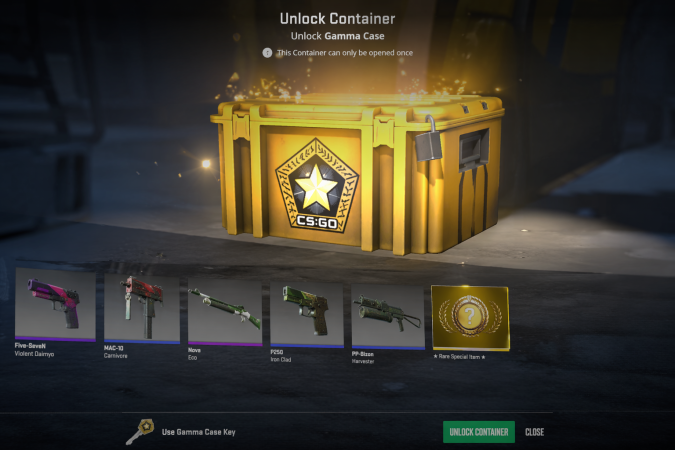

If you have spent any time around CS2 lately, you have seen it. Somebody opens a case. The reel slows down. A red skin flashes past. Chat loses its mind. Then the whole thing happens again five minutes later.
That is the trick.
Case opening looks simple, but it is built around the same loop that keeps people glued to slot spins, card packs, and random drops. It feels fast, exciting, and just skill-adjacent enough to stop players from calling it what it often is: gambling with Counter-Strike branding on top.
What A CS2 Case Actually Is
A case in CS2 is a loot box. You get one skin from it, picked at random from the case pool. Most cases hold around 15 to 18 weapon skins, plus the really rare stuff at the top end, like knives or gloves. To open one, you need the case itself and a key bought through Steam. The standard key price is $2.49, so call it roughly €2.30 before you even pay for the case.
The important bit is that the item is not only random by name. The wear is random, too. So even if you hit a good skin, its condition can still push the value up or down.
You can get cases from weekly drops by levelling up, buy them on the Steam Community Market, or pick them up through third-party trading sites. Most players get pulled in by the easy version first: one case, one key, one shot at something flashy.
How Opening One Actually Works
The process is almost stupidly simple, which is part of why it works so well.
You:
- Get or buy a case
- Buy a key
- Hit open
- Watch the animation
- Hope the result lands on something expensive
That last part is where all the tension lives. The opening animation is the whole show. You see better items slide past. You get the near miss. You get the fake feeling that you were “close.” Then the game hands you a blue skin worth less than your lunch and quietly asks if you want another go.
This is why case opening feels so much like casino play. The mechanic is not complicated. The emotion is. You are paying for suspense, not just the item.
What Players Are Hoping To Pull
Most case openings land on common or low-tier items.
- The drop rate for Mil-Spec blue items at 79.92%.
- Restricted purple sits at 15.98%.
- Classified pink drops to 3.2%.
- Covert red is 0.64%.
- The gold-tier “Rare Special Item” category, which is where knives and gloves usually live, sits at 0.26%.
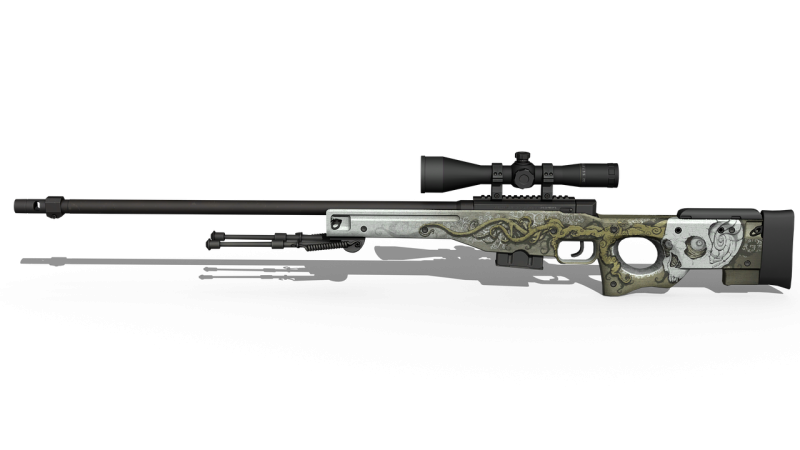
Part of that is the skin culture itself. A Chroma 3 Case can hold skins like P250 Asiimov and M4A1-S Chantico’s Fire, plus the rare knife drop. Other cases build their whole reputation around one or two standout pulls. The names matter because the market values them. A good knife or glove drop can jump from “nice clip” to “why is this worth hundreds or thousands?” very quickly.
So, Is It Basically Gambling?
Honestly, yes, close enough.
People can dress it up however they want. They can call it opening cases, chasing skins, supporting the economy, or “just having fun.” But if you are paying money for a random shot at a prize with real market value, the gambling comparison is not some dramatic stretch. It is the obvious one.
The core case-opening pitch is simple:
- You might lose money
- You might hit a rare item
- And the system is built so most people do the first one
That is why even case-opening guides tend to land on the same blunt conclusion. If your goal is profit, opening cases is usually a bad deal.
Why Players End Up Looking at Casinos Too
The link to casinos is not hard to see once you strip the branding away. CS2 case opening runs on the same stuff that keeps casino games moving. You pay, you get a random outcome, you watch the reveal, and you hope the next result fixes the last one. That is why the whole thing feels so familiar to anyone who has spent time around slots, prize wheels, or other fast reward systems.
But before anyone even creates an account at a casino, the first thing to check is the license. That sounds dull, but a license tells you who is supposed to supervise the operator, what rules it is meant to follow, and whether there is at least some proper structure behind the site.
Curaçao is one of the names we keep seeing now because it sits behind a huge number of offshore casinos. Those casinos are some of the most popular ones these days because they usually offer big game libraries, broad bonus menus, and a more flexible setup than tighter local markets. The license itself has also become more structured than many players still assume. The current Curaçao Gaming Authority system is more formal, more controlled, and much easier to verify than the old version people still picture when they hear the name.
We even found this site, Curacao Online Casinos, fully dedicated to Curacao casinos only. They list and group different casinos that hold a Curacao license. So, if you would like to transition from CS2 cases to casinos, Curacao casinos are the place to start.
Why It Hooks Players So Fast
The short answer is that CS2 cases borrow the strongest parts of gambling without making players walk into a casino first.
You get:
- Random outcomes
- Visible rarity tiers
- A flashy reveal
- The chance of profit
- Social proof from clips and streams
- A built-in market that gives every drop a price tag
That last part matters more than people admit. A case opening is not only “did I get something cool?” It is “Did I get something worth more than I paid?” The second money shows up in the conversation, and the whole thing changes. It stops being a toy and starts behaving like a wager.
The scale of it says a lot, too. In March 2025 alone, at least 32 million CS2 cases were opened. At $2.49 per key, that meant over $82 million in key revenue, and more than $100 million once Steam marketplace cuts were folded in. That is not a side hobby anymore. That is a machine.
Players also keep feeding each other the loop. One person posts a knife pull. Someone else thinks, “Why not me?” Then they open ten cases and get three skins worth less than the sandwich they ignored to do it.
Are Cases Ever “Worth It”?
If you treat them like entertainment and keep the budget stupidly small, maybe. That is the most generous answer.
If you treat them as a way to make money, then no, not really. The numbers do not support that fantasy. The odds are bad, the average return is weak, and the emotional high mostly comes from chasing outcomes that almost never land. Even the “best” cases still tend to lose players around 30% to 40% on average.
That does not mean nobody should ever open one. It means people should call the thing what it is before they start feeding it.
