

In this guide
- The Strategy Starts With the First Move
- Seeing Every Card Changes Everything
- Why Empty Space Is the Most Valuable Resource
- Almost Every FreeCell Deal Can Be Won
- Short Games Can Still Demand Serious Thinking
- Why FreeCell Feels Made for the Browser
- A Classic That Has Survived Generations of Computers
- The Rules Stay the Same. The Problems Never Do
FreeCell wastes very little time.
The moment a game begins, the entire puzzle is already sitting in front of you: 52 visible cards, eight tableau columns, four free cells and four foundations.
There is no opening cinematic, no complicated progression system and no hidden card waiting to rescue a bad decision. You look at the board, work out what needs moving and start making choices.
That simplicity is one of FreeCell's greatest strengths. It also makes the classic card game particularly well suited to modern browsers.
FreeCell takes seconds to start, only a few minutes to understand and considerably longer to master. Beneath its familiar playing cards is a surprisingly intricate strategy game in which small decisions can determine whether a seemingly straightforward deal becomes a victory or a dead end.
The Strategy Starts With the First Move
The objective sounds simple: move all 52 cards onto four foundation piles, building each suit from Ace through King.
The challenge is getting them there.
At the beginning of a standard game, the deck is distributed across eight columns. Four contain seven cards, while the remaining four contain six. Every card is face up.
Within the tableau, cards can be arranged in descending order using alternating colours. A red seven, for example, can be placed beneath a black eight.
The four free cells provide temporary storage, allowing players to move individual cards out of the way. Empty tableau columns create additional space for reorganising longer sequences.
None of these rules is particularly difficult to remember.
What makes FreeCell interesting is that almost every useful move involves a trade-off.
Moving a card into a free cell might expose an important Ace, but it also removes a valuable storage space. Building a long sequence might make the board look tidier, but that sequence could become difficult to relocate later.
FreeCell doesn't spend ten minutes preparing you for the interesting decisions.
The first move is already one of them.
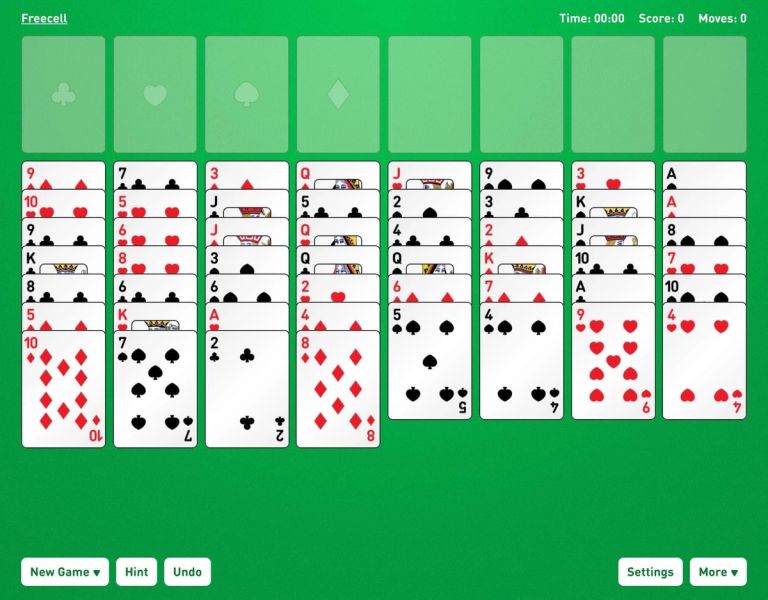
Screenshot: A FreeCell board on Online-Solitaire.com, illustrating the game's familiar layout.
Seeing Every Card Changes Everything
FreeCell belongs to the solitaire family, but it differs significantly from the version many people first encountered on Windows.
In Klondike Solitaire, much of the deck begins face down. Players must reveal hidden cards and work with whatever the draw pile provides.
FreeCell removes that uncertainty.
Every card is visible from the opening deal. There is no stock pile, no unexpected reveal and no fresh card arriving to change the situation.
The entire puzzle is available for inspection.
That makes mistakes feel different.
When a position becomes difficult, the problem frequently began several moves earlier. Perhaps two free cells were occupied unnecessarily. Maybe an empty column was filled too quickly, or an important card was transferred to a foundation before the remaining tableau was ready.
The frustrating part is that these decisions often look perfectly reasonable when they happen.
The consequences emerge several moves later.
This delayed cause and effect gives FreeCell much of its strategic depth. Winning is not simply about identifying legal moves. It is about understanding which moves will leave the greatest number of possibilities available.
For anyone interested in how different solitaire variations approach challenge and accessibility, GamerBolt's guide to the best free online solitaire games explores several other ways the familiar card-game formula has evolved.
Why Empty Space Is the Most Valuable Resource
One of FreeCell's cleverest ideas is that the most useful part of the board often contains no cards at all.
Consider a position in which three of your four free cells are occupied.
With no empty tableau columns, you can move a correctly ordered sequence of only two cards using the remaining free cell as temporary storage.
Free up one additional cell and that capacity increases to three cards.
Create an empty tableau column and the possibilities expand further. With two free cells available and one usable empty column, you can potentially transfer a six-card sequence onto another occupied column.
Many digital versions handle these longer transfers automatically through what players call supermoves, provided the sequence could be moved legally using the available space.
This is where FreeCell starts to resemble a problem of resource management.
A free cell is not merely somewhere to park an inconvenient card. It helps determine how much of the board you can manipulate.
An empty column is even more valuable because it can temporarily accommodate multiple cards while allowing you to rebuild sequences elsewhere.
Sometimes occupying that column immediately is the correct decision. Other times, keeping it empty for another few moves creates far more opportunities.
The strongest move is not necessarily the one that clears the most cards.
It is often the one that preserves the most freedom.
Almost Every FreeCell Deal Can Be Won
FreeCell has another unusual quality: nearly every standard deal is theoretically solvable.
That does not mean every game is easy. It means the starting arrangement usually contains at least one sequence of legal moves that leads to victory.
The most famous exception is deal number 11982.
Of the original 32,000 numbered Microsoft FreeCell deals, 31,999 have known solutions. Number 11982 is the one that cannot be completed under the standard rules.
The wider history of FreeCell's rare unwinnable deals makes the game particularly interesting.
Unlike a card game that can defeat a player through an unfortunate hidden draw, FreeCell generally offers a solution from the beginning.
The challenge is discovering it.
This distinction makes losing surprisingly motivating. If a seemingly impossible position emerges, there is a good chance that a different sequence of earlier moves would have produced a much better result.
You can restart, rethink the opening and approach the same deal from another direction.
It is a small but powerful reason to keep playing.
Short Games Can Still Demand Serious Thinking
Not every strategy game needs an elaborate campaign, a complicated technology tree or several hours of uninterrupted attention.
FreeCell can provide a satisfying challenge in a relatively short session.
Some deals begin with several obvious opportunities to expose low cards and build foundations. Others present awkward stacks that require careful planning before any meaningful progress becomes possible.
Even an apparently generous opening can become difficult if the available space is used carelessly.
The game keeps asking the same fundamental questions in slightly different ways.
Are you improving the board or simply moving a problem somewhere else?
Would clearing a column now unlock more possibilities later?
Is a foundation move genuinely helpful, or will the tableau need that card again?
Those questions are easy to understand but not always easy to answer.
Importantly, FreeCell rarely needs to introduce new rules to keep its challenges interesting.
A different shuffle is usually enough.
Why FreeCell Feels Made for the Browser
Modern browser gaming covers an enormous range of experiences, from small puzzle games to sophisticated multiplayer titles.
As GamerBolt's selection of the best browser games demonstrates, convenience remains one of the format's most appealing qualities.
FreeCell takes that convenience to its logical conclusion.
The game does not require elaborate graphics, large downloads or specialist controls. A readable deck, responsive card movement and a straightforward way to restart a deal provide the essentials.
Players can play FreeCell online and get straight into the experience without installing anything.
Modern browser implementations can also build on the familiar formula without changing the underlying game. FreeCell Now, for example, offers difficulty selections, daily challenges and numbered deals, allowing players to choose between a relatively approachable puzzle and something considerably more demanding.
These options suit FreeCell particularly well because they provide variety without interfering with its simplicity.
A beginner might want an easier arrangement with room to experiment. Someone more experienced can revisit difficult numbered deals, compare different approaches or attempt to complete a challenging board more efficiently.
The browser also makes it easy to return to a game between other activities.
There is no lengthy setup before the interesting part begins.
Load the board. Examine the cards. Make a move.
That is enough.
A Classic That Has Survived Generations of Computers
FreeCell's origins stretch back much further than the modern web.
Paul Alfille developed a computer version for the PLATO educational computer system during the 1970s. Jim Horne subsequently helped bring the game to personal computers, with Microsoft's version becoming particularly familiar during the Windows era.
Its inclusion in Windows 95 introduced FreeCell to an enormous audience of everyday computer users.
For many people, the game became part of the same desktop tradition as Minesweeper and Solitaire: something immediately recognisable, accessible and easy to return to.
Screenshot: FreeCell running on the GNOME desktop in 2006. Image: Russell Boltz, Wikimedia Commons, GPL.
Looking at older computer versions, what stands out is how little the essential design has changed.
The cards still occupy familiar columns. The free cells remain crucial. The foundations still need to be completed in suit order.
The graphics, controls and platforms have evolved, but the central puzzle remains almost untouched.
Few games can maintain that level of consistency without beginning to feel outdated.
FreeCell manages it because the challenge comes from the interaction between simple rules rather than technological spectacle.
The Rules Stay the Same. The Problems Never Do
Perhaps the best explanation for FreeCell's longevity is also the simplest.
It offers a complete strategic problem using an ordinary deck of cards.
Every piece of information is visible. Every move can have consequences. Every empty space matters.
Some deals reward an aggressive opening. Others require patience and careful preservation of free cells. One arrangement might become manageable after a single column is cleared, while another demands an entirely different approach.
And because the rules stay consistent, players gradually develop a deeper understanding of why their decisions succeed or fail.
That sense of improvement is enormously satisfying.
FreeCell never needed constant reinvention, complicated rewards or endless new features to remain entertaining.
Its design was already strong enough.
Modern browsers simply make that familiar experience easier to access, whether someone has five minutes to spare or wants to spend considerably longer solving a difficult deal.
More than anything, FreeCell demonstrates that a good game doesn't have to be complicated.
Sometimes 52 cards, four empty cells and a little room to think are more than enough.

Written by
Jessica ThompsonAs a dedicated gaming journalist with over five years of experience, I've immersed myself in the ever-evolving world of video games. Currently, I contribute to Gamerbolt.com and PS6news.com, where I cover the latest in gaming news, in-depth game reviews, and industry trends. At Gamerbolt.com, I've had the privilege of shaping content strategies, writing comprehensive articles, and engaging with a passionate community of gamers. My role involves not only crafting engaging narratives but also staying ahead of the curve with the latest gaming innovations and upcoming titles.