

In this guide
- What Pokémon Cards Are Worth Grading?
- The Most Valuable Pokémon Cards Worth Grading: Top 16 Ranked
- 1. Pikachu Illustrator — The Ultimate Pokémon Collectible
- 2. Rayquaza Gold Star — An EX-Era Masterpiece
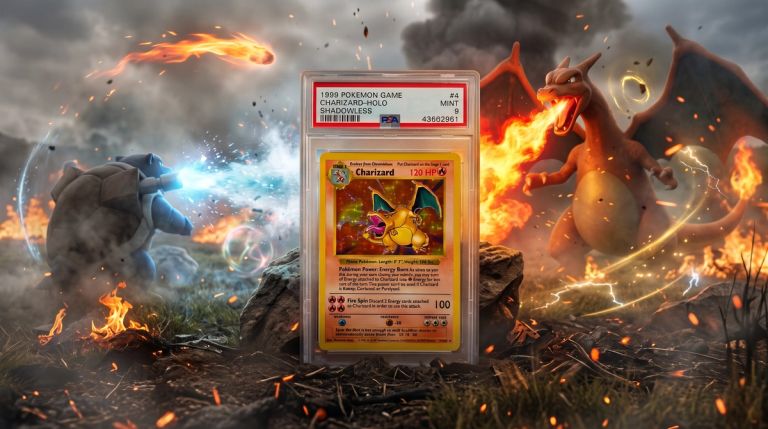
- 3. First Edition Shadowless Charizard — The Vintage Benchmark
- 4–5. Trophy Kangaskhan and Japanese No Rarity Charizard
- 6–11. Gold Stars, Crystal Pokémon and Shining Cards
- 12–16. The Best Modern Pokémon Cards to Grade
- How Much Does Pokémon Card Condition Affect Grading?
- Which Pokémon Grading Company Should You Choose?
- How Much Does Pokémon Card Grading Cost in 2026?
- Is Grading a Pokémon Card Actually Profitable?
- How to Tell Whether Your Pokémon Card Is Worth Grading
- Should You Grade Damaged Pokémon Cards?
- Vintage vs Modern Pokémon Cards: Which Are Better to Grade?
- Five Pokémon Cards You Should Think Twice About Grading
- Is It Better to Sell Pokémon Cards Raw or Graded?
- The Future of Pokémon Card Grading
- Frequently Asked Questions
- Final Verdict: Which Pokémon Cards Should You Grade?
Some Pokémon cards are worth a few pounds. Others have sold for hundreds of thousands — or even millions — of dollars. The difference often comes down to three things: rarity, condition and whether a professional grading company has certified the card.
In February 2026, a PSA 10 Pikachu Illustrator sold for an astonishing $16.492 million, setting a world record for a trading card sold at auction. Just six months later, a CGC Pristine 10 Rayquaza Gold Star achieved $1.02 million. These exceptional sales demonstrate just how valuable the right Pokémon card can become.
But here's the important part: not every valuable Pokémon card is worth grading, and not every card graded 10 will generate a profit.
An original Charizard with visible wear might still deserve professional authentication. A modern card worth £30, meanwhile, could actually lose money after grading fees, shipping and selling costs.
So, which Pokémon cards should you actually send for grading?
This guide ranks some of the most desirable cards to inspect, explains what separates valuable vintage Pokémon cards from modern chase cards, compares grading services and shows how to determine whether submitting a card makes financial sense.
What Pokémon Cards Are Worth Grading?
The best Pokémon cards to grade generally combine strong collector demand, genuine scarcity and condition that supports their market value.
| Card category | Grading potential | What to look for |
|---|---|---|
| Rare trophy and competition promos | Exceptional | Authenticity, provenance and rarity |
| First Edition Base Set holos | Very high | Original stamps, condition and genuine print variants |
| Gold Star Pokémon | Very high | Surface condition, authenticity and low high-grade populations |
| Crystal Pokémon and Shining cards | Very high | Original holo finishes and scarce pristine examples |
| Vintage Charizard, Lugia and Umbreon holos | High | Popularity, print version and remaining condition |
| Modern alternate-art and special illustration rares | High, but selective | Strong demand and realistic PSA 10 potential |
| Limited-distribution promotional cards | Variable to high | Documented scarcity and active collector interest |
| Ordinary modern holographics | Usually low | Grade only when economics or personal significance justify it |
| Common and uncommon bulk cards | Usually very low | Unusual historic variants or exceptional condition rarity |
For collectors making decisions across an entire binder, comparing potential returns using resources dedicated to the best Pokémon cards to grade can help identify cards where the possible grading premium outweighs the fees and risks.
However, estimates should always be checked against completed sales and the specific card's condition.
The Most Valuable Pokémon Cards Worth Grading: Top 16 Ranked
Before looking at everyday submissions, it helps to understand the cards at the top of the market.
The ranking below is an editorial guide to prominent, high-value grading candidates, considering collector significance, rarity, demand and high-grade value potential. It is not a definitive worldwide price ranking: rare trophy sales are infrequent, different grading companies have different standards, and individual results can be distorted by exceptional provenance.
| Rank | Pokémon card | Set or origin | Collector tier | Grading recommendation |
|---|---|---|---|---|
| 1 | Pikachu Illustrator | 1998 Japanese competition promo | Record-setting trophy | Authenticate regardless of cosmetic condition |
| 2 | Rayquaza Gold Star | EX Deoxys, 107/107 | Elite rarity | Extremely strong candidate |
| 3 | 1st Edition Shadowless Charizard | Base Set, 4/102 | Iconic vintage | Grade even with significant wear |
| 4 | Kangaskhan Family Event Trophy | 1998 Japanese promo | Trophy rarity | Authentication is a major priority |
| 5 | Japanese No Rarity Charizard | Original Japanese Expansion Pack | Historic first printing | Strong candidate |
| 6 | Umbreon Gold Star | POP Series 5, 17/17 | Elite rarity | Grade in most authentic conditions |
| 7 | Crystal Charizard | Skyridge, 146/144 | Rare vintage | Excellent grading candidate |
| 8 | 1st Edition Lugia | Neo Genesis, 9/111 | Vintage icon | Prioritise clean holos |
| 9 | 1st Edition Shining Charizard | Neo Destiny, 107/105 | Vintage secret rare | Strong demand at several grades |
| 10 | Torchic Gold Star | EX Team Rocket Returns, 108/109 | Scarce EX-era card | Grade with careful condition assessment |
| 11 | Pikachu Gold Star | EX Holon Phantoms, 104/110 | High-value EX era | Strong candidate |
| 12 | Umbreon VMAX alternate art | Evolving Skies, 215/203 | Modern icon | Inspect closely for a high grade |
| 13 | Giratina V alternate art | Lost Origin, 186/196 | Modern chase | Prioritise exceptionally clean copies |
| 14 | Gengar VMAX alternate art | Fusion Strike, 271/264 | Modern chase | Strong candidate if grading premium works |
| 15 | Umbreon ex special illustration rare | Prismatic Evolutions, 161/131 | Modern chase | Check centering and current sales |
| 16 | Charizard ex special illustration rare | Pokémon 151, 199/165 | Popular modern card | Grade selectively |
Important: These cards vary enormously in value. A rare tournament promo may justify grading at a low numeric grade, while an easily available modern chase card needs a much closer examination of the likely grading premium.
Verified Pokémon Card Auction Results in 2026
Rather than treating online asking prices as market values, here are several documented sales.
| Pokémon card | Grade | Recorded sale | Date |
|---|---|---|---|
| Pikachu Illustrator | PSA 10 | $16,492,000 | February 2026 |
| Rayquaza Gold Star, EX Deoxys | CGC Pristine 10 | $1,020,000 | August 2026 |
| 1st Edition Base Set Charizard | PSA 10 | $504,000 | May 2026 |
| 1st Edition Base Set Charizard | PSA 9 | $60,000 | July 2026 |
| Unlimited Base Set Charizard | PSA 10 | $26,700 | May 2026 |
Sources: Guinness World Records and completed Fanatics Collect auctions. Values are individual transaction results, including applicable buyer's premiums, not guaranteed prices or general estimates for other copies.
Two important lessons emerge. First, exceptional grades can carry enormous premiums. Second, the precise version of a card matters just as much as the Pokémon featured on it.
A 1st Edition Charizard and an Unlimited Charizard may feature almost identical artwork, but they are not interchangeable collectibles.
1. Pikachu Illustrator — The Ultimate Pokémon Collectible
The Pikachu Illustrator sits in a category almost entirely of its own.
Awarded through Japanese illustration competitions associated with CoroCoro Comic in the late 1990s, this distinctive card was not a normal booster-pack pull. Its artwork was created by Atsuko Nishida, the original designer of Pikachu.
In February 2026, Logan Paul's PSA 10 example sold through Goldin Auctions for $16,492,000, a result officially recognised by Guinness World Records.
Why does that matter for grading?
Because with genuinely scarce trophy cards, authentication may be just as important as the numeric grade. A card does not need to be pristine to be exceptionally valuable when only a small number were originally distributed.
Any ungraded example believed to be genuine would warrant professional evaluation, provenance research, careful insurance arrangements and an appropriately qualified grading service.
Verdict: An extraordinary authentication priority, although virtually no ordinary collector will encounter a genuine example.
2. Rayquaza Gold Star — An EX-Era Masterpiece
The 2005 Rayquaza Gold Star from EX Deoxys is among the most desirable Pokémon cards of the 2000s.
Its artwork shows a shiny-coloured Rayquaza extending beyond the traditional illustration frame, a signature characteristic of the Gold Star series.
The card combines several powerful collecting characteristics: a popular legendary Pokémon, difficult original availability, striking artwork and limited surviving examples at the very highest grades.
In August 2026, a CGC Pristine 10 example sold for $1.02 million through Fanatics Collect.
That result needs context. The card was described as the only Pristine example of its kind, so the transaction should not be used to estimate the value of an ordinary PSA 9 or damaged raw copy.
Even so, Rayquaza Gold Star is an excellent example of a card where professional grading can make sense without a realistic expectation of perfection.
Verdict: Grade authentic examples in most conditions, but research the actual card's likely grade before choosing a service tier.
3. First Edition Shadowless Charizard — The Vintage Benchmark
Few trading cards are more recognisable than the original Charizard from Pokémon's Base Set.
Yet collectors must distinguish between three major English-language versions:
| Version | Identifying feature | Relative collectibility |
|---|---|---|
| 1st Edition Shadowless | First Edition stamp and no shadow beside artwork frame | Highest of the three |
| Shadowless | No First Edition stamp or artwork-frame shadow | Scarcer than Unlimited |
| Unlimited | Drop shadow on the right of the artwork frame | More widely distributed |
The difference is critical.
A collector who discovers a Charizard in an old binder should inspect its printing before making any assumptions about price.
A genuine 1st Edition Shadowless example may justify grading despite scratches, corner wear or whitening. An Unlimited example requires more attention to its condition and potential resale value.
The 2026 sales of PSA 10 First Edition examples above $500,000 illustrate the extreme importance of high-grade scarcity. However, this is not a realistic valuation for a typical childhood card.
Verdict: Nearly every authentic 1st Edition Base Set Charizard deserves serious grading consideration. Unlimited copies require individual assessment.
4–5. Trophy Kangaskhan and Japanese No Rarity Charizard
Two other categories belong near the top of any serious grading shortlist.
Kangaskhan Family Event Trophy is a Japanese promotional card associated with a 1998 parent-and-child tournament. It attracts collectors because it was distributed through a particular event rather than through general retail packs.
A genuine example is a specialist collectible, where identifying the correct release and confirming authenticity are essential.
Japanese No Rarity Charizard is associated with the earliest Japanese Pokémon card printings. The absence of a rarity symbol is an important identifying characteristic, but collectors must verify the exact card and release rather than assuming every Japanese Charizard without an obvious symbol is a valuable first printing.
These are precisely the situations where relying on visual similarity or generic online search results can be expensive.
Verdict: Both deserve expert attention, particularly when authenticity or printing identification is uncertain.
6–11. Gold Stars, Crystal Pokémon and Shining Cards
For serious vintage collectors, these groups deserve substantial attention.
Gold Star Pokémon
Gold Star cards were released during the EX era and are known for unusual shiny-coloured artwork and distinctive gold-star symbols beside Pokémon names.
Umbreon, Pikachu, Torchic and Rayquaza are particularly desirable examples, although the entire Gold Star series contains cards worth investigating.
A key advantage is that their appeal is not necessarily dependent on receiving a perfect grade. Scarcity and collector demand may support meaningful values even when cards show wear.
Crystal Pokémon
Crystal cards from sets such as Aquapolis and Skyridge are prized for their distinctive designs and limited availability.
Crystal Charizard is especially desirable, but collectors also seek other Crystal Pokémon such as Lugia and Ho-Oh.
The delicate finishes and age of these cards make surviving high-grade copies attractive.
First Edition Neo-era cards
Lugia from Neo Genesis and Shining Charizard from Neo Destiny represent another premium vintage collecting category.
Condition matters enormously. Early holofoil cards can suffer from print lines, scratching and silvering or whitening around their edges.
A clean-looking childhood card should therefore never be assumed to be a PSA 10.
Verdict: Prioritise Gold Stars, Crystal cards and rare First Edition holos for inspection. These often have a stronger case for grading at imperfect grades than ordinary modern cards.
12–16. The Best Modern Pokémon Cards to Grade
Modern Pokémon cards have developed an enormous collecting audience.
Popular releases such as Evolving Skies, Fusion Strike, Lost Origin, Pokémon 151 and Prismatic Evolutions introduced premium artwork that has become highly desirable.
However, modern grading economics are fundamentally different.
While a vintage card may have survived decades of handling, a modern card might have been placed into a protective sleeve immediately after opening.
This increases the supply of apparently clean copies and means a PSA 9 may command only a modest premium over an ungraded example.
Umbreon VMAX — Evolving Skies
Often nicknamed Moonbreon, Umbreon VMAX 215/203 has become one of the defining modern alternate-art Pokémon cards.
Its distinctive nighttime artwork and immense popularity make it a serious grading candidate.
The catch is population. Thousands of professionally graded examples exist, meaning collectors should not assume that a PSA 10 is genuinely rare simply because the card itself is expensive.
Check the grade-specific market and population reports before submitting.
Giratina V — Lost Origin
Giratina V 186/196 is another celebrated alternate-art card.
Its complex illustration and strong collector interest make it appealing, but that intricate artwork can make surface inspection particularly important.
Fine scratches, print imperfections and subtle edge damage should all be checked carefully.
Gengar VMAX — Fusion Strike
Gengar VMAX 271/264 is popular for its unusual and memorable illustration.
Demand for Gengar gives the card an established collector audience, but profitability still depends on the price difference between raw, PSA 9 and PSA 10 copies.
Umbreon ex — Prismatic Evolutions
The special illustration rare Umbreon ex 161/131 has attracted attention from modern collectors.
Like Moonbreon, however, its desirability should not be confused with guaranteed grading profitability.
Compare the current selling prices and examine both sides meticulously.
Charizard ex — Pokémon 151
Pokémon 151 brought the original generation back into focus with modern artwork and familiar characters.
Charizard ex 199/165 is an obvious candidate for collectors, but it is also a useful example of why popularity alone is insufficient.
A flawless copy may justify grading. A copy with noticeable whitening, off-centering or a surface defect may be better left ungraded.
Verdict: Modern chase cards are often excellent grading candidates when clean, but should be judged against the likely PSA 9 outcome rather than simply the highest advertised PSA 10 price.
How Much Does Pokémon Card Condition Affect Grading?
Professional grading companies evaluate several aspects of a trading card's condition.
The four most important factors are centering, corners, edges and surface.
| Condition factor | What graders examine | Problems to watch for |
|---|---|---|
| Centering | Alignment of artwork and printed borders | Uneven borders, shifted printing |
| Corners | Sharpness and preservation | Soft corners, bends, whitening |
| Edges | Condition around the card | Chips, rough edges, silvering |
| Surface | Front and back condition | Scratches, dents, stains, print lines |
Grading standards vary between companies.
According to PSA's published grading standards, a PSA 10 is a virtually perfect card, with approximate front-centering tolerance of 55/45 and reverse-centering tolerance of 75/25.
That does not mean any card within those dimensions automatically qualifies for a 10. Every other aspect of its condition must also meet the standard.
PSA 10 vs PSA 9 vs PSA 8: Why One Grade Matters
| Grade | General condition | Typical decision for modern cards |
|---|---|---|
| PSA 10 — Gem Mint | Virtually perfect | Often the most commercially attractive outcome |
| PSA 9 — Mint | Nearly perfect, minor imperfections | Worthwhile when the graded premium covers costs |
| PSA 8 — Near Mint-Mint | Excellent, but with more noticeable imperfections | Often poor economics for common modern cards |
| PSA 7 and below | Increasing degrees of wear | Usually reserved for valuable or sentimental examples |
Vintage cards require a different approach.
A PSA 6 First Edition vintage holo could still be desirable because of its scarcity. An ordinary modern card graded PSA 6 may struggle to attract interest beyond buyers who specifically want an affordable graded example.
Which Pokémon Grading Company Should You Choose?
Three of the most established grading companies are PSA, Beckett Grading Services and CGC Cards.
| Grading company | Main advantage | Particularly suitable for |
|---|---|---|
| PSA | Established grading market and widespread recognition | Vintage and modern resale-oriented submissions |
| Beckett (BGS) | Detailed subgrades and prestigious Black Label designation | Exceptionally clean cards with strong subgrade potential |
| CGC Cards | Established collectible authentication and distinct Pristine grading | Modern and vintage TCGs, including UK submissions |
PSA
PSA is a popular choice for collectors interested in selling cards.
Its grading scale is widely recognised, and buyers frequently compare PSA 9 and PSA 10 sale prices.
However, that popularity does not eliminate the risk of receiving an unexpectedly low grade.
Beckett
Beckett evaluates centering, corners, edges and surface using individual subgrades.
Its Black Label Pristine 10 designation requires exceptionally strong results across all four criteria.
This makes it attractive for exceptional cards, but collectors should not submit an ordinary modern card expecting a Black Label simply because it looks perfect in a sleeve.
CGC Cards
CGC offers Gem Mint 10 and the more demanding Pristine 10 designation.
For UK collectors, its established London submission arrangements can also make the logistics of grading more straightforward.
Whichever service you choose, compare real completed sales for that specific company's grade. A CGC 10, PSA 10 and Beckett Black Label 10 should not be assumed to have identical resale values.
How Much Does Pokémon Card Grading Cost in 2026?
Grading costs depend on the company, service tier, declared value, turnaround expectations and submission location.
For example, CGC's UK fee schedule introduced in March 2026 lists a Bulk tier at £14 excluding VAT per card, subject to a 25-card minimum, and an Economy tier at £17 excluding VAT.
Higher-value or expedited submissions can cost considerably more. Packaging, applicable handling charges, shipping and insurance must also be considered.
Always check the current CGC UK grading fees or PSA service prices before placing an order.
Do not make the mistake of comparing a card's raw price against its PSA 10 price without accounting for these costs.
Is Grading a Pokémon Card Actually Profitable?
This is arguably the most important question of all.
A card can increase in market value after grading without generating a financial profit for its owner.
Consider a hypothetical modern Pokémon card with the following sale prices:
| Outcome | Hypothetical sale value |
|---|---|
| Ungraded | £100 |
| PSA 10 | £180 |
| PSA 9 | £110 |
| PSA 8 | £80 |
Suppose grading, shipping and related submission expenses total £30.
If the card receives PSA 10, the increase in gross sale value is £80, leaving £50 before any selling fees.
If the card receives PSA 9, the increase is just £10 — less than the grading expenses.
At PSA 8, the card might actually sell for less than its original raw value.
That is the crucial difference between possible profit and realistic expected profit.
The Grading Profit Formula
A useful starting point is:
For a more accurate calculation, the expected graded proceeds should account for different potential grades, their estimated probabilities and marketplace selling fees.
For example, rather than treating a PSA 10 as guaranteed, consider a 25% chance of a 10, 55% chance of a 9 and 20% chance of an 8.
These are only illustrative probabilities, not predicted grading results. Nevertheless, they demonstrate how a promising top-grade premium can become a much less attractive opportunity once the possibility of lower grades is included.
Collectors can use grading-return tools to perform this comparison, but should treat probability estimates as guides rather than promises.
How to Tell Whether Your Pokémon Card Is Worth Grading
A sensible grading decision begins well before a card is packaged for submission.
Step 1: Identify the Exact Card
Check the name, set, card number, language, rarity symbol and any First Edition or promotional markings.
Use the official Pokémon Trading Card Database to help distinguish releases.
Remember that artwork can be reused across different products and reprints.
Step 2: Check Completed Sales
Find actual transactions involving the same card.
Start with recent ungraded sales, then compare PSA 8, PSA 9 and PSA 10 results where enough data exists.
eBay's completed listings guidance explains how collectors can research comparable sales.
Do not use an unsold listing at an unrealistic asking price as proof of market value.
Step 3: Inspect the Card Under Good Lighting
Remove the card from its sleeve carefully, handling it by the edges.
Examine the front and back using a clean surface and suitable lighting.
Look for scratches, dents, whitening, chips and unusual surface marks.
Avoid attempting to clean, press, alter or repair the card. Improper treatment can reduce value or create problems with grading eligibility.
Step 4: Compare the Grade-Specific Market
Check recent sale prices and consult the PSA Population Report.
A population report shows how many examples of a particular card PSA has graded at each level.
It does not reveal every ungraded copy that exists, and population numbers can change as additional cards are submitted.
A low population is meaningful only when paired with genuine collector demand.
Step 5: Choose a Realistic Outcome
For a vintage card with obvious scratches, do not base the submission on a hypothetical PSA 10.
For a modern card, consider what happens financially if it receives a PSA 9 rather than a 10.
If the numbers only work under an extremely optimistic scenario, waiting may be the better choice.
Step 6: Package and Submit Correctly
Follow the grading company's packaging instructions.
Suitable protective sleeves, supported semi-rigid holders and secure shipping are commonly used, but specific requirements differ.
For valuable cards, select appropriate insurance and a service tier that accommodates the card's declared value.
Should You Grade Damaged Pokémon Cards?
Sometimes, absolutely.
It depends on what makes the card valuable.
A damaged 1st Edition Charizard, a rare Gold Star or an authentic Japanese tournament promo may still benefit from professional grading.
Authentication establishes confidence, while the holder provides a consistent way to describe condition.
By contrast, a common modern card with a crease is unlikely to become significantly more desirable simply because it has received a low grade.
The key distinction is that rarity can preserve value in imperfect condition, but grading cannot manufacture demand for a card nobody particularly wants.
A lower grade is not necessarily a failure. For a scarce historical card, it may be a perfectly appropriate way to document and protect what survives.
Vintage vs Modern Pokémon Cards: Which Are Better to Grade?
| Consideration | Vintage cards | Modern cards |
|---|---|---|
| Main attraction | Nostalgia, historic significance, scarcity | Artwork, popular Pokémon and current collector demand |
| Condition challenges | Decades of handling and storage damage | Print quality, centering and surface imperfections |
| Importance of PSA 10 | Extremely important for maximum value, but not always essential | Often central to profitability |
| Value of lower grades | Can remain substantial for rare cards | Frequently limited |
| Supply of clean copies | Often restricted | Can be substantial |
| Best grading approach | Prioritise rarity and authenticity | Prioritise condition and grade-specific margins |
For people who enjoy games alongside collecting, the enthusiasm that carries classic franchises into remakes and their next generation of hardware has a close parallel in the Pokémon TCG.
Collectors continue to celebrate the original cards while embracing artwork and rarities from newer sets.
Yet the economics remain different. A modern chase card may be popular precisely because thousands of people want it. A rare vintage trophy card may be expensive partly because almost nobody can obtain one.
Neither category is automatically a better purchase or grading candidate. The actual card matters.
Five Pokémon Cards You Should Think Twice About Grading
There are several situations where professional grading can be difficult to justify.
- Common modern holographics: Attractive designs are not always scarce. Ordinary holos may have plenty of clean copies available.
- Low-value promotional cards: Many promotional releases are produced in substantial quantities. A promo designation alone does not imply rarity.
- Modern chase cards with obvious flaws: A card can have strong market demand but still produce poor grading economics if a PSA 10 is unrealistic.
- Unlimited vintage non-holos: Some are collectible, particularly in exceptional condition, but age alone does not justify a grading fee.
- Cards purchased solely to chase a perfect grade: Buying a raw card at a premium without inspecting it personally introduces an additional layer of risk.
There are exceptions within every category. Population scarcity, unusual variants, collector demand and sentimental importance can change the decision.
Is It Better to Sell Pokémon Cards Raw or Graded?
Selling ungraded can be an excellent decision.
You avoid grading fees, delays and the uncertainty of the result. For cards with relatively modest values, this can preserve more of the eventual proceeds.
Grading becomes more attractive when it offers something the raw market cannot provide as easily: third-party authentication, greater buyer confidence, a clearly communicated condition or a substantial price premium.
Collectors should also consider timing.
A modern card may experience strong demand immediately after release, followed by changing prices as more products are opened and more graded copies enter the market.
If grading takes several months, the final resale opportunity may differ significantly from the market conditions at submission.
That is why the right question is not simply whether a card could be valuable in a slab.
It is whether grading provides enough additional benefit to justify its costs and risks.
The Future of Pokémon Card Grading
Professional grading has become a significant part of the modern collectibles industry.
Collectors increasingly expect access to certification databases, population reports, clear grading standards and digital tools for tracking card values.
Technology is also changing how submissions are researched and assessed. CGC, for example, has described the use of technology to assist with measurement and authentication.
Academic research into business-model innovation within the trading-card grading industry has examined how grading businesses adapt through technology, trust and customer engagement, with these developments potentially helping collectors focus on the cards and their collecting decisions.
Still, no automated estimate should be treated as a guaranteed professional grade.
Whether a collector uses magnification, population statistics or AI-assisted pre-grading, the final certification decision belongs to the chosen grading company.
Frequently Asked Questions
What is the most valuable Pokémon card in 2026?
The Pikachu Illustrator holds the record for a Pokémon card sold at auction following the $16,492,000 sale of a PSA 10 copy in February 2026.
That is a specific exceptional transaction, not the value of every Pikachu Illustrator.
Are all First Edition Pokémon cards worth grading?
No. First Edition markings can improve collectibility, but the card, set, condition and demand must still justify grading.
A First Edition holographic Charizard has a very different market from an ordinary First Edition common card.
Is a PSA 9 Pokémon card worth anything?
Yes. Many rare vintage cards are extremely valuable at PSA 9, and some modern cards command meaningful premiums.
However, certain common modern cards may be worth little more at PSA 9 than when sold ungraded.
Is it worth grading a £20 Pokémon card?
Usually not for purely financial reasons.
If total submission expenses are comparable to or greater than the card's value, grading needs to deliver a substantial premium to make commercial sense.
Personal collecting and display preferences are valid reasons to grade a lower-value card.
Can a damaged Charizard still be valuable?
Definitely. The original printing, rarity and authenticity may be much more important than perfect condition.
A damaged rare vintage Charizard could be collectible, whereas a damaged mass-produced modern version may have limited resale value.
Does a card fresh from a Pokémon booster pack guarantee PSA 10?
No. Factory printing imperfections, off-centering, damaged edges and surface defects can exist before a card is ever handled by its owner.
Pack-fresh and Gem Mint are not interchangeable descriptions.
Is PSA better than CGC or Beckett?
There is no universal best choice.
PSA is widely recognised in the resale market, Beckett offers distinctive subgrades and Black Label certification, and CGC provides established TCG grading services.
Choose based on current prices, the card's characteristics, service costs and what collectors actually pay for comparable grades.
Should I grade Pokémon cards for long-term investment?
Grading can help with authentication, preservation and resale, but it does not guarantee future appreciation.
Collectible prices can decline, demand can shift and even rare cards can be difficult to sell quickly.
Treat grading as part of a collecting or resale strategy, not a guarantee of investment returns.
Final Verdict: Which Pokémon Cards Should You Grade?
The strongest grading candidates are generally rare vintage cards, desirable Gold Stars, valuable tournament promotions and exceptionally clean modern chase cards.
If you own a First Edition Charizard, rare Gold Star, Crystal Pokémon or historic promotional card, professional grading deserves serious consideration even when the condition is imperfect.
For modern cards, be more selective. A popular Umbreon, Gengar or Charizard may look impressive in a slab, but the numbers should still work if the grade is lower than expected.
Before submitting anything, identify the precise card, investigate completed sales, inspect its condition and calculate the true cost of grading.
The best Pokémon card to grade is not necessarily the most expensive card in your collection.
It is the one where authentication, condition certification and genuine collector demand create enough additional value to make grading worthwhile.

Written by
Jessica ThompsonAs a dedicated gaming journalist with over five years of experience, I've immersed myself in the ever-evolving world of video games. Currently, I contribute to Gamerbolt.com and PS6news.com, where I cover the latest in gaming news, in-depth game reviews, and industry trends. At Gamerbolt.com, I've had the privilege of shaping content strategies, writing comprehensive articles, and engaging with a passionate community of gamers. My role involves not only crafting engaging narratives but also staying ahead of the curve with the latest gaming innovations and upcoming titles.