
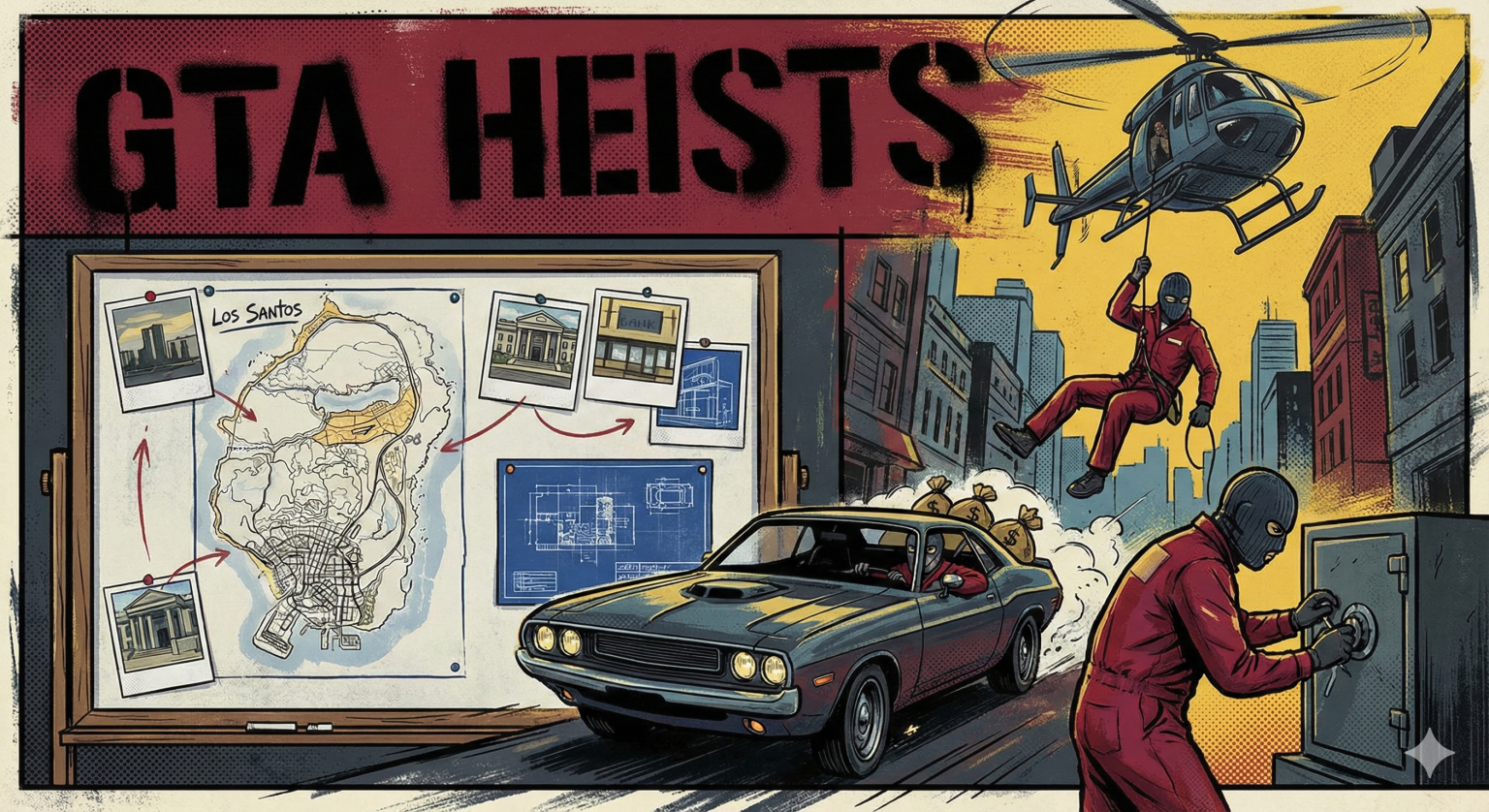

When Rockstar released Grand Theft Auto V in 2013, it wasn’t just another open-world sandbox full of fast cars and shootouts. It was a revolution in storytelling. By weaving together three very different protagonists—Michael, Franklin, and Trevor—the game managed to pull off something no other title had done before. It made the player feel like the mastermind of a cinematic crime saga.
The brilliance of GTA V’s narrative lies not in the gunfights or the explosions, but in how the game uses its three-character structure to give heists depth, tension, and unpredictability. It’s not just fun to play—it feels like you’re directing a blockbuster.
Why Three Is the Magic Number
Most games focus on a single protagonist, letting players experience the world through one lens. But GTA V took a gamble. By giving us Michael, Franklin, and Trevor, Rockstar created a triangle of perspectives that clash, complement, and evolve throughout the story.
Switching between them doesn’t just spice up gameplay—it changes how we perceive the same world. Michael’s life of privilege contrasts with Franklin’s hustle, while Trevor’s chaotic existence crashes through both. This setup made every mission feel layered and dynamic.
Players who already bought it on Eneba – GTA 5 key quickly made them realize that the storytelling isn’t just about individuals—it’s about the friction between them.
The Heist Blueprint
Nowhere is the multi-protagonist structure more impactful than in GTA V’s heists. These aren’t just missions—they’re the game’s narrative centerpiece. Each heist requires planning, choosing the right crew, and deciding your approach. But the real magic comes during execution.
One moment, you’re Franklin, carefully navigating the getaway car. With a click, you’re Michael, covering the team from a rooftop. Seconds later, you’re Trevor, screaming through the sky in a chopper with wild abandon. It’s seamless, cinematic, and utterly exhilarating.
This constant switching builds tension. You’re not watching the action unfold—you’re in charge of every moving part. That sense of control, paired with the unpredictability of each protagonist’s personality, makes every heist unforgettable.
The Personal Stakes
What makes GTA V’s storytelling so effective isn’t just mechanics—it’s the human element. Each character brings his own baggage to the table. Michael’s midlife crisis and craving for redemption clash with Franklin’s hunger for upward mobility. Trevor, meanwhile, is a living embodiment of chaos, a reminder that not all plans go smoothly.
These conflicting motivations give the heists emotional weight. They’re not just about money—they’re about pride, freedom, betrayal, and survival. When you pull off a successful score, it feels earned because you’ve juggled not just logistics but egos.
A Cinematic Masterclass
In many ways, GTA V is less like a traditional video game and more like an interactive movie. The heists play out like set pieces ripped straight from Hollywood blockbusters—think Heat or The Italian Job. But unlike those films, you’re not a passive spectator. You’re the director, the actors, and the editor all at once.
By perfecting multi-protagonist storytelling, Rockstar blurred the line between cinema and gaming. It proved that video games could tell stories as nuanced and thrilling as any movie—and in some cases, even better.
The Lasting Legacy
Over a decade later, GTA V still stands as the gold standard for narrative design in gaming. Its three-character structure hasn’t just aged well—it’s become iconic, shaping expectations for what an open-world game can deliver.
And the best part? Experiencing it is easier than ever. With a GTA 5 key, you can jump into Los Santos and relive the thrill of directing the most stylish, chaotic, and brilliantly told crime story in gaming history.
Because at the end of the day, GTA V’s heists aren’t just about the score—they’re about proving that storytelling in games can be as bold and ambitious as the biggest blockbusters. That’s a legacy worth revisiting, especially with the Eneba digital marketplace.
