
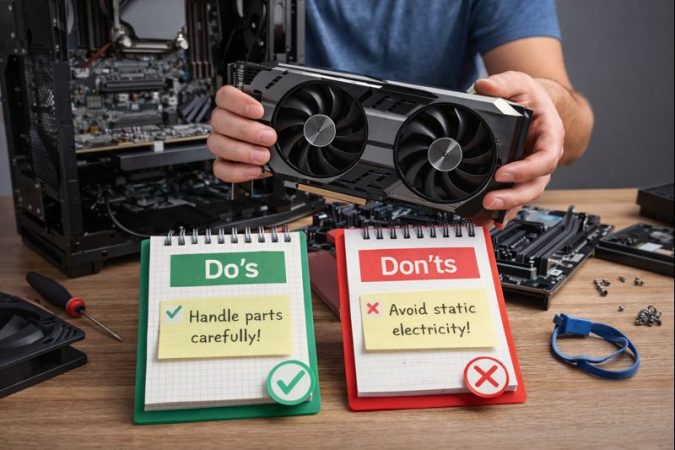

Building your first PC is a rite of passage and a truly unforgettable experience. You don’t want to remember it for all the wrong reasons, though! To make things easier, here’s a rundown of what you should and shouldn’t do, from prep through building mistakes to first post-building steps.
Do: Research Based on the Type of PC You Need
Component harmony is the basis of any good build, no matter your budget. Ask yourself what kind of PC you’re building and go from there. For example, a gaming PC will require the best graphics card your budget allows for, while video editing, simulations, or 3D modeling benefit equally from the best CPUs and more RAM.
It’s also worth thinking beyond hardware. The software you rely on, how you connect online, and the stability you need for competitive or latency-sensitive tasks all influence build decisions. Some of those considerations, including network optimization tools like VPN for gaming, are easier to address once the core system is in place.
Don’t: Needlessly Overspend
Knowing where you can cut corners will let you spend more on the essentials. Motherboards are a great example. The vast majority of people don’t need the overclocking support and other high-end features offered on expensive motherboards. You’ll also see few gains by going with PCIe 5.0 SSDs unless you transfer terabytes of data daily. RAM clocked at more than 6000MHz with tight timings doesn’t make sense either, especially for gaming at high resolutions.
Do: Install Everything You Can on the Motherboard First
The motherboard is your PC’s hardware hub, so installing it first and going from there sounds logical. In reality, you’ll be skipping a lot of stress if you connect everything you can while the mobo is lying down horizontally on the desk first. That means the CPU, its cooler (don’t forget the thermal paste!), the RAM, and the M.2 SSD(s).
Don’t: Zap Your Components
Static can build up all too easily during a build, especially if you’re in a dry room and wearing clothes that conduct electricity well. Remove each component from its anti-static bag only when it’s time to install it. Handle them by the edges and occasionally touch the case or other metal objects to ground yourself. An anti-static bracelet can help too.
Do: Prepare the OS Install Beforehand
Whether you’re a Windows User or fawn over the latest Linux distros, the operating system is the first thing to install. It won’t appear out of thin air, though – you’ll either get a bootable drive with your copy or need to create one from an online installer. Ask a friend or PC shop to set you up so you don’t waste time on the big day.
Don’t: Forget those XMP / EXPO Profiles
The beastly RAM you bought can’t reach its potential without enabling its advertised frequency in the BIOS! XMP was the gold standard and is still recommended for Intel chipsets. EXPO is a solid alternative if you’re on AMD’s AM5 platform. Both technically support either technology, but it’s best to check the packaging and go with the native option.
Do: Streamline the Initial Setup
Once your OS is up and running, it’s time for the tedious task of installing all your programs. Make a list of the essentials beforehand and use sites like Ninite to speed up the process. It’s a good idea to set up a VPN first to limit exposure if you’re downloading the rest from a public or shared connection, like the Wi-Fi in your college dorm.
Don’t: Neglect Your Security and Privacy
With everything else ready, it’s time to either create or sync accounts for the operating system, apps, game launchers, etc. It’s healthy to treat this as a new start, so see if any accounts need new passwords and make sure that new ones have unique credentials protected by multi-factor authentication.
It’s also smart to think about how your new PC connects to the internet. Installing a reputable VPN client helps protect your traffic from tracking, especially on shared or public networks, and reduces how much data is exposed as you browse, play, or download. Combined with responsible online habits, this goes a long way toward keeping your setup private and secure from day one.
