


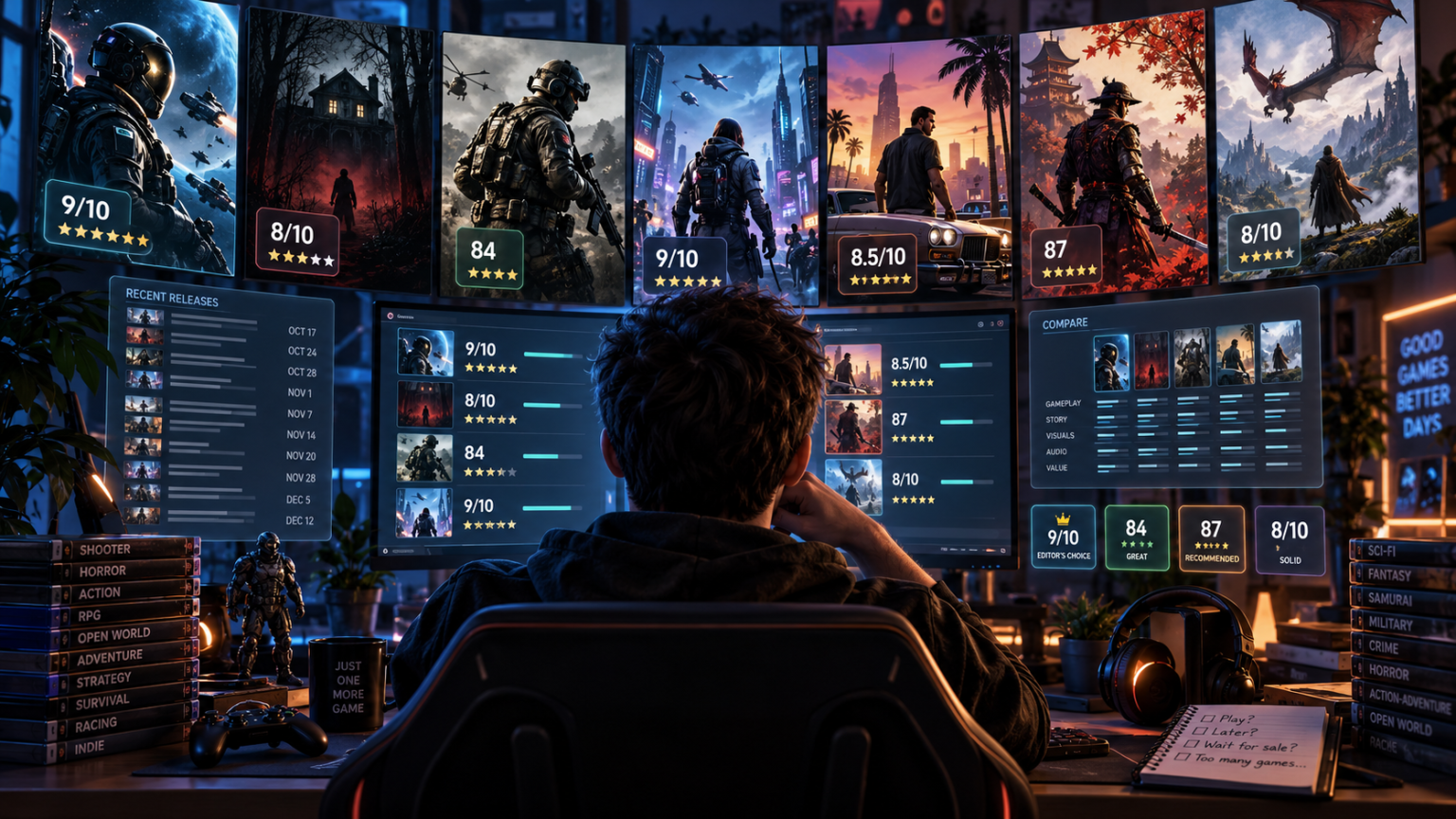

Gaming has developed a strange problem: there is almost too much to play.
A packed release calendar sounds brilliant until several games you have been waiting years for arrive within weeks of each other. Add an ever-growing backlog, subscription libraries, multiplayer games that demand regular attention and titles that can easily swallow 50 or 100 hours, and buying a new game becomes more of a decision than it once was.
Very few players have unlimited time or money. When three promising games arrive in the same month, something has to give.
That is why reviews, recommendations and aggregated scores remain useful even in an age when trailers, livestreams and hours of gameplay footage are available before most people spend a penny.
A Review Is Really a Shortcut
The most useful thing a reviewer offers isn’t a number at the bottom of the page. It is time.
Someone has already played the game, worked through its systems and discovered whether the brilliant-looking combat from the trailer remains enjoyable after 20 hours. They have found the bugs, experienced the difficulty curve and worked out whether the story actually goes anywhere.
For somebody deciding between two £60 or £70 releases, that experience matters.
Review aggregators take the idea one step further. Rather than relying on one person’s opinion, players can see how dozens of critics responded to the same game.
Metacritic explains its Metascore as a weighted average created from the scores of a selected group of critics.
That does not make an aggregate score an objective measurement of whether a game is “good”. It does, however, make it an extremely fast way of seeing whether critical opinion is broadly positive, divided or negative.
The number gives you somewhere to start. The reviews underneath it tell you why.
The Reviewer Matters More Than the Number
Two reviewers can play exactly the same game and come away with completely different opinions without either of them being wrong.
A player who loves difficult combat and learning complicated systems might consider a demanding action game one of the year’s highlights. Someone who mainly plays games to relax after work could find exactly the same design exhausting.
That is why the most useful reviews show their working.
At GamerBolt, our own product review guidelines require scores to be supported by examples, data or comparisons rather than simply attaching a number to a product. The same principle applies particularly well to games.
How long did the reviewer play? Which platform did they use? What worked? What didn’t? Did technical problems materially affect the experience?
Those details tell you much more than the difference between an 8/10 and an 8.5/10 ever could.
Over time, players also learn which reviewers have tastes similar to their own. If somebody regularly loves the same RPGs, shooters or strategy games you do, their recommendation may eventually become considerably more valuable to you than the average score.
We Use the Same Shortcut Everywhere
Gaming isn’t unique here.
Modern consumers face an absurd amount of choice, and almost every large online market has developed its own version of the review score.
Before buying headphones, people compare specifications and user ratings. Before booking a hotel, they look through guest reviews. Film fans check critic and audience scores before spending an evening on something.
Even heavily regulated industries use comparison guides. Someone researching the UK’s casino operators, for example, is likely to encounter comparisons covering areas such as regulation, game selection, payment methods and offers rather than assessing every operator personally.
The subject is different, but the reason comparison content exists is essentially the same: there are too many options for most people to investigate every one from scratch.
Gaming reviews perform that filtering job for us.
The important part is understanding what is being measured.
A headset receiving praise for competitive FPS audio doesn’t automatically make it the best choice for somebody who wants cinematic single-player sound. Likewise, a game praised for delivering 100 hours of content isn’t automatically better value to someone who would rather experience an exceptional ten-hour campaign.
Launch Scores Aren’t the End of the Story
Reviews also have an obvious limitation: games change.
The version available to critics before launch may not be the version people are playing six months later.
Updates can improve performance, rebalance mechanics, fix bugs and add major pieces of content. Online games can change even more dramatically as maps, modes, weapons and progression systems evolve.
The reverse can happen too. A game that reviews brilliantly can develop problems once millions of players arrive and put its servers under pressure.
We have seen plenty of releases fail to live up to enormous expectations, which is why looking back at some of gaming’s biggest video game disappointments is a useful reminder that hype and final quality are not necessarily the same thing.
This is also why revisiting games matters.
A launch review answers one important question:
Is this worth playing now?
It cannot always answer another:
Will this still be worth playing a year from now?
For live-service games in particular, the second question can end up being much more important.
Scores Work Best as the Beginning, Not the Answer
There is nothing wrong with looking at a review score before deciding what to buy. When several expensive games arrive close together, it would be strange not to use the information available.
The mistake is treating a number as the entire verdict.
An 85 does not mean everybody will like a game more than one sitting at 82. A divisive 70 can become somebody’s favourite game of the year, while a universally praised blockbuster can leave another player completely cold.
Instead, use scores to narrow the field.
Then find out why reviewers liked or disliked something, watch a little gameplay and consider whether the qualities being praised actually match what you enjoy.
With more games competing for our attention than ever, good criticism isn’t there to tell us what we are allowed to like.
It simply makes finding the games we are most likely to enjoy a lot easier.
