




Scroll through the average gamer’s phone and you find a strange lineup living side by side. A live-service shooter that eats a couple of hours every weekend. A gacha RPG that gets a daily login and little else. A cozy farming sim for winding down before bed. And somewhere in that stack, a slots app with a grinning cartoon mascot spinning reels for coins. A decade ago the last one would have felt like a tourist in the wrong neighborhood. In 2026 it barely earns a second glance.
The reason is not that gamers suddenly discovered gambling. It is that social casinos are built by the same kind of studios, using the same design habits, as the free-to-play titles already sitting in everyone’s rotation. They run on daily bonuses, collection meters, seasonal events, and the exact variable reward loop that makes a rare drop feel electric. If you want the plain-language version of how this free-to-play corner works, GamingToday keeps a running explainer on social casinos that separates the play-money coin systems from the real-money gambling most people picture when they hear the word casino.
This article looks at the category the way a player would, not the way a finance columnist would. What are these games actually made of? Why do they fit so neatly beside a battle pass grind? And what should you understand about spending, odds, and a fast-changing legal picture before one of them earns real time on your screen?
Why a Free-to-Play Slots App Ended Up in Your Library
Social casinos are not new. Their ancestors were the Facebook poker and slots games of the early 2010s, the ones your relatives kept sending requests for. What changed is the surrounding hobby. Free-to-play stopped being a dirty phrase and became the default business model for a huge slice of gaming, from hero shooters to card battlers to the endless parade of mobile idle games.
Once players got comfortable spending small amounts on cosmetics, battle passes, and character pulls, the mental distance between those purchases and a coin-based slots app shrank to almost nothing. The interface is familiar. The reward cadence is familiar. The only real difference is the theme on top: reels and card tables instead of dragons and rifles.
That familiarity is why the category quietly grew into one of the larger corners of casual gaming. It did not need to convert people to a new habit. It borrowed one that free-to-play design had already trained across the entire hobby.
You can see the same borrowing in how these games market themselves. The trailers, the seasonal cosmetics, the limited-time crossover events tied to a holiday or a pop-culture moment all read like the promotional calendar of any live-service game. A player who follows weekly gaming news is used to that rhythm of drops and events, so a social casino running a summer festival with new machines and bonus coins feels like business as usual rather than a pitch from a different industry.
The Design DNA They Share With Your Backlog
Pull apart a modern social casino and you will recognize almost every part from games you already play. The daily login bonus is the same hook a mobile RPG uses to keep a streak alive. The tiered progression that hands out badges and opens new machines is a battle pass wearing a different costume. Even the coin store, with its tempting mid-size bundles priced just above the free daily allowance, mirrors the storefront in any live-service title.
The deepest shared thread is the variable reward. Slot logic and gacha logic are cousins. Both sell you an attempt rather than a guaranteed outcome, and both pull the result from a hidden pool of possibilities. A ten-pull in a mobile gacha and a spin on a virtual reel are the same behavioral engine with different art. Designers lean on anticipation, near-miss framing, and unpredictable payouts because those elements keep hands moving and sessions long. That is not something anyone hides; it is the stated engagement model.
The boards that rate games noticed the overlap years ago. When ratings groups started flagging randomized purchases, they deliberately bundled loot boxes, gacha pulls, item packs, prize wheels, and treasure chests under one umbrella, because from a mechanics standpoint they all do the same thing. A social casino simply removes the fantasy wrapper and shows you the reel directly.
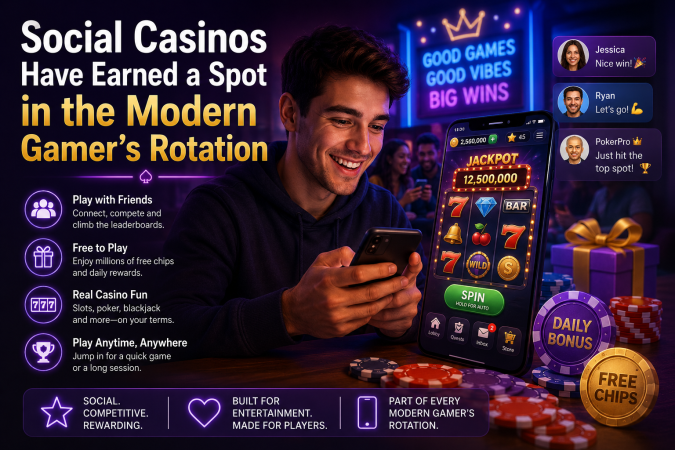
Free-to-Play Actually Means Free Here, With a Two-Coin Twist
Here is the part that trips people up. A reputable social casino is genuinely free to play, and it is legally distinct from a real-money online casino. Real-money online casinos, where you deposit cash and cash out winnings directly, are licensed in only a small number of US states. Social casinos operate almost everywhere by using a different structure entirely.
Most of them run on two currencies. The first is a play-money coin, often called Gold Coins, that you can buy in bundles but that holds no cash value and can never be redeemed for money. It exists purely to keep the reels spinning. The second is a promotional coin, often called Sweeps Coins, that you do not buy directly. You receive it as a bonus attached to coin purchases, through daily giveaways, or by mailing in a free request, and under sweepstakes rules it can be redeemed for prizes.
That second path, the free mail-in entry, is the legal spine of the whole model. Because there is always a no-purchase way to get the redeemable coin, operators argue the game is a promotional sweepstakes rather than gambling. It is the same legal logic behind a fast-food collect-and-win game or a soda bottle-cap contest, applied to a slots interface. Whether that logic holds is exactly what several states are now testing, which we will get to.
Where Social Casinos Sit Among the Free-to-Play Genres
It helps to see the category next to its neighbors rather than on its own. The table below lines up four familiar free-to-play shapes by how you pay and what you actually stand to gain or lose.
| Game type | How you spend | What you can walk away with | Typical mindset |
|---|---|---|---|
| Gacha RPG | Buy premium currency for character or item pulls | In-game units and gear, no cash value | Collect and build a roster |
| Battle-pass shooter | Buy seasonal pass and cosmetics | Skins and emotes, no cash value | Grind tiers, look sharp |
| Social casino (sweeps model) | Optional Gold Coin bundles, free entry available | Prizes via redeemable Sweeps Coins in many states | Casual spins, small stakes feel |
| Real-money online casino | Deposit real cash | Direct cash winnings | Gambling, licensed states only |
The pattern is clear once it is laid out. Three of the four rows are free-to-play at their core, and the social casino is the only one of that group where the promotional currency can turn into a prize. That single feature is what makes it feel more charged than a cosmetic purchase, even though the entry point is the same free-to-play door.
What Keeps Them in the Rotation After a Long Session
Ask why a player who just finished a two-hour raid opens a slots app, and the honest answer is decompression. Social casinos ask for nothing. No reflexes, no team coordination, no learning curve, no risk of tanking a ranked streak. You tap, the reels move, a jingle plays, and your brain gets a small, no-stakes hit of surprise. For a lot of people that is the perfect palate cleanser between heavier games.
They also fit the shape of modern attention. A round lasts seconds, which suits the same commute-and-couch minutes that mobile puzzle games fill. That is the same low-friction habit that keeps players checking our monthly picks for the best new games and then jumping between three or four titles in an evening. The social casino is just one more tab in that rotation, competing for the same idle minutes as everything else.
There is a social layer too, true to the name. Leaderboards, gifting, clubs, and shared events borrow straight from the community features of larger games. When your friends are chasing the same weekly event, the pull is less about the reels and more about not falling behind the group, which is the same gravity that keeps guilds and clans logging in. Some titles add cooperative goals where a whole club works toward a shared coin pool, turning a solo pastime into a group errand that is easy to keep showing up for. It is a small design touch, but it is lifted directly from the playbook that keeps raid teams and squad-based shooters coming back night after night.
The Numbers Most Players Skim Past
The comfortable framing has a sharper side that is easy to miss. Social casinos make most of their money from a tiny fraction of users. Industry analyses suggest only around one in eight players ever makes a first purchase, a conversion rate far below the more than half seen on licensed real-money gambling apps. The free crowd costs the operator very little and mostly serves as an audience.
The revenue comes from the minority who spend, and among that group the average spend per paying user runs unusually high. Reporting on the segment has described individual players losing amounts in the five- and six-figure range, well past anything a casual mobile game would produce. The whale concept that live-service games talk about openly applies here with extra weight, because the coins in question can carry redeemable value.
The overall market has grown accordingly. Estimates vary, but analyses of the sweepstakes social segment place it well into the billions of dollars a year, with some putting it above ten billion at its recent peak. That growth mirrors what happened with mobile gacha titles a few years earlier, where a similar small slice of dedicated spenders funded games that millions played for free. None of that is meant to scare anyone off a free spin. It is meant to make clear that the business is engineered around a small number of heavy spenders, and knowing where you sit on that curve is worth a moment of honesty before you tap the coin store.
Where the Law Is Drawing Lines in 2025 and 2026
For years the sweepstakes structure let these games operate in places where real-money gambling is off the table. That gray zone is narrowing fast. Montana moved first, with a law signed in May 2025 that took effect on October 1 of that year and became the first explicit statewide ban on the model. Connecticut followed with its own measure taking effect the same day.
California then delivered the heaviest blow. AB 831, signed into law by the governor, bars dual-currency sweepstakes casinos from operating in the state as of January 1, 2026, and it does not stop at operators. The law extends liability to payment processors, geolocation providers, content suppliers, and media affiliates that support the platforms, which makes it far harder for the format to quietly continue. Because California is such a large market, analysts estimated the ban erased a meaningful share of the whole segment’s US revenue in one move. Worth stating plainly: real-money online casinos were never legal in California, and this new law tightens the rules on the free-to-play sweepstakes model on top of that.
Other states have taken the enforcement route instead of new statutes. Attorneys general in several states, including Louisiana, have leaned on existing gambling and consumer-protection law to send cease-and-desist letters to operators rather than waiting on legislation. The practical takeaway for a player is simple: whether these games are available to you now depends heavily on your state, and that answer is changing month to month.
Keeping It in the Fun Column
The healthy way to treat a social casino is the same way you would treat any free-to-play game with a store attached. Decide before you open it whether you are spending anything, and if so, cap it at an amount that would not sting if it vanished, exactly the mental budget you would set for a battle pass or a bundle of character pulls. The moment a session shifts from unwinding to trying to win something back, the fun has left the building.
A few habits keep it in check. Use the free daily coins and the mail-in entries rather than reflexively buying bundles. Turn off the one-tap purchase confirmations that make spending frictionless. Watch the clock, since the endless-round design is built to blur time. And keep in mind that the same randomized mechanics carry a formal warning in the wider hobby: ratings boards attach a specific notice for randomized in-game purchases, the label covering loot boxes and similar mechanics, precisely because the reward math is designed to keep you pulling.
Treated with that awareness, a social casino is a fine addition to a varied rotation, a light snack between the main courses of your library. The trouble only starts when the snack becomes the meal. Play it like the free-to-play game it is, know how the coins and the law actually work, and it earns its slot without any drama.
Frequently Asked Questions
Are social casinos the same as online gambling?
Not in the legal sense. Real-money online casinos take cash deposits and pay cash directly, and they are licensed in only a handful of US states. Social casinos run on a free-to-play sweepstakes structure with a no-purchase entry path, which is why they operate in many more places, though a growing number of states are restricting or banning the model.
Do I have to spend money to play one?
No. The core loop is genuinely free, and reputable operators provide daily coin giveaways plus a free mail-in method to obtain the redeemable currency. Buying Gold Coin bundles is optional and only speeds up how long you can keep spinning; it is not required to reach the games or the prize path.
Why do these games feel so much like the mobile titles I already play?
Because they are built on the same design toolkit. Daily bonuses, progression tiers, seasonal events, and variable reward pulls come straight from free-to-play mobile design. Slot mechanics and gacha mechanics are close relatives, which is why a social casino feels instantly familiar to anyone who has ground out a battle pass or chased a rare pull.
What changed legally in 2025 and 2026?
Several states moved against the sweepstakes model. Montana and Connecticut passed bans that took effect on October 1, 2025, and California’s AB 831 bars dual-currency sweepstakes casinos from operating there starting January 1, 2026, while also extending liability to vendors that support them. Other states have used cease-and-desist letters under existing law.
Is it easy to lose track of spending?
It can be, which is the main thing to respect. A small share of players account for most of the revenue, and reported losses among heavy users reach into the thousands and well beyond. Setting a fixed budget, leaning on the free coins, and disabling one-tap purchases keep a social casino in the entertainment column where it belongs.
