




If you spend your evenings raiding dungeons, grinding ranked ladders, or building cities one block at a time, you already understand a digital world governed by rules. Online casino play in the United States runs on a similar logic, except the rules are written by state legislatures rather than game studios, and they change from one border to the next. A gamer in New Jersey can legally spin a slot on a licensed app, while a gamer in California sitting a few time zones away faces a completely different set of options. The patchwork can feel as confusing as a poorly documented patch note.
This guide breaks down what real-money online casino regulation actually looks like across the country in 2026, why the map is so uneven, and what that means for anyone who treats gaming as a serious hobby. For readers who want a structured place to check the status of a particular state before they sign up anywhere, Lineups state-specific online casino information collects the legal picture, available operators, and current promotions in one reference. Treat the sections below as the context you need to read a resource like that with a critical eye.
Why The Rules Differ From State To State
The reason online casino law looks like a quilt rather than a single sheet comes down to a simple constitutional fact: gambling in the United States is regulated primarily at the state level. There is no federal statute that turns online casinos on or off nationwide. Each state decides for itself whether to authorize, tax, and license real-money internet gaming inside its own borders.
That decentralized structure is why a game studio can ship the same title to every console in the country, but an online casino operator cannot offer the same product everywhere. The operator has to win a license in each individual jurisdiction, build geofencing technology to confirm a player is physically located inside that state, and follow rules written by that state’s gaming commission. The result is the uneven coverage that frustrates so many players who assume a legal app in one place will work in another.
The decentralized model also explains why the legal map can change fast. A single state legislature passing one bill can flip a market from prohibited to live, while a neighboring state with similar demographics stays closed for years because a competing interest, a tribal compact, or a budget fight stalls the effort. For a player, this means the only constant is that there is no national answer, only a stack of separate state answers that have to be checked one at a time.
A useful comparison is regional storefront availability in gaming. A title can be rated and sold in one country and held back in another because of local content rules, even though the underlying game is identical. Online casinos work the same way, except the gating happens at the state line and is enforced in real time by software rather than by a storefront decision made once before release.
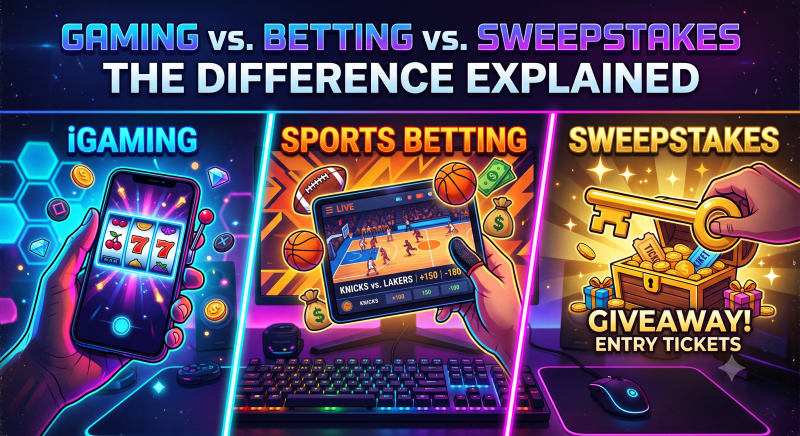
The Difference Between iGaming, Sports Betting, And Sweepstakes
Before going state by state, it helps to separate three categories that get mixed together in everyday conversation. They are regulated differently, and confusing them is the most common mistake new players make.
Real-money online casino gaming, often called iGaming, covers slots, blackjack, roulette, video poker, and live dealer tables played for cash through a licensed operator. This is the most tightly restricted category and is legal in only a small group of states.
Online sports betting is a separate authorization. Many states that have legalized betting on football, basketball, and esports have not legalized online casino gaming at all. The two markets are governed by different laws and sometimes different agencies, which is why a player might be able to bet on a match legally while having no legal way to play a slot.
Sweepstakes and social casinos form a third group. These platforms let players use virtual currency and, in some models, redeem prizes, operating under promotional and sweepstakes law rather than gambling statutes. They are available in far more states, but they are not the same as a licensed real-money casino, and the legal ground beneath them has grown contested as several states move to restrict the model.
Knowing which bucket applies to you saves a lot of wasted effort. Players routinely download an app, complete a lengthy signup, and only then discover that the product offered in their state is sports betting alone, or a sweepstakes model rather than the real-money casino they expected. Sorting the category first turns a frustrating dead end into a quick yes or no.
The States Where Real-Money Online Casinos Are Legal
As of mid-2026, the club of states with fully legal, regulated real-money online casino gaming remains small. A small group of states have live markets where you can download a licensed app and play slots and table games for cash, led by New Jersey, Pennsylvania, and Michigan.
Each of these markets launched on its own timeline and runs under its own conditions. New Jersey, which went live back in 2013, is widely treated as the template the rest followed. Pennsylvania and Michigan arrived later and quickly grew into two of the largest markets in the country. Maine passed legislation in 2025 to authorize iGaming, though the law did not take effect until early 2026 and the market needs time to build out before players see live products.
The table below summarizes the regulated states and the agency that oversees each one.
| State | Online casino status | Regulator |
|---|---|---|
| New Jersey | Live | NJ Division of Gaming Enforcement |
| Pennsylvania | Live | PA Gaming Control Board |
| Michigan | Live | Michigan Gaming Control Board |
| West Virginia | Live | WV Lottery Commission |
| Connecticut | Live | CT Dept. of Consumer Protection |
| Delaware | Live | Delaware Lottery |
| Rhode Island | Live | RI Lottery / Dept. of Business Regulation |
| Maine | Authorized, building out | Maine Gambling Control Unit |
There is a second reason that headline count understates the picture. Several large states, including New York, Illinois, and Maryland, have repeatedly debated iGaming bills without passing them, which means the count of live states can shift between legislative sessions. A gamer following the space should treat any list, including this one, as a snapshot rather than a permanent fixture.
If you live outside these states, any site claiming to offer you real-money casino play is almost certainly an offshore operator working without a US license. That distinction matters enormously, and the later sections explain why.
How Big The Regulated Market Has Actually Become
The small number of legal states hides how much money moves through them. Regulated iGaming revenue in the United States reached record levels in 2025, climbing at a strong double-digit pace in a single year. For context, the broader commercial casino industry, counting land-based venues, sports betting, and internet gaming together, posted record revenue above 78 billion dollars that year.
Pennsylvania stood out as the largest iGaming market, with statewide online revenue rising sharply year over year. One detail signals how the category is maturing: in both Pennsylvania and New Jersey, annual iGaming revenue surpassed revenue from physical commercial casinos for the first time in 2025. The online side of the business is no longer the junior partner in those states.
For gamers, those figures explain why studios, payment companies, and game developers pour resources into the format. A market growing at that rate attracts the same talent and design attention that flows into mainstream video games, which is part of why the products increasingly borrow from familiar gaming conventions.

Why Online Casinos Feel More Like Video Games Every Year
Anyone who has played a current online slot has probably noticed how much it resembles a mobile game. Progression meters, unlockable features, seasonal events, and avatar customization have migrated straight from free-to-play design. That convergence is deliberate, and it is one reason the line between casino content and gaming content keeps blurring.
The donor publication you are reading has covered this shift in detail, examining how online casinos are drawing inspiration from modern game design trends by adopting RPG-style systems, cinematic visuals, and community features. For a gamer, recognizing those mechanics is useful precisely because they are engineered to extend play sessions. The same psychological hooks that keep you logging into a live-service game are at work in a real-money product, except here the stakes are your wallet rather than your rank.
Understanding the design intent does not mean the games are unfair. Licensed operators in regulated states run audited random number generators and publish return-to-player figures. It does mean that treating these products as entertainment with a built-in cost, rather than as a strategy to make money, keeps your expectations honest.
It is also worth understanding what the return-to-player number actually promises and what it does not. A published RTP of 96 percent describes the long-run mathematical average across millions of spins, not a guarantee for any single session. The same logic applies to a loot system in a game you grind for hours: the drop rates are statistical, and short stretches can swing well above or below the average. Reading these figures the way a seasoned player reads patch notes, as expected values rather than promises, is the healthiest mental model to bring to a real-money product.
What Legal Play Requires Of You As A Player
Playing on a licensed platform involves more friction than firing up a game on Steam, and that friction is the point. Regulated operators are legally required to verify who you are and where you are.
Identity verification, often called KYC, asks for your legal name, date of birth, address, and usually the last digits of your Social Security number, along with a document upload to confirm you are who you claim. Age verification enforces the minimum age, which is 21 in most regulated states. Geolocation software checks that your device is physically inside the state’s borders every time you play, not just when you create the account. If you cross a state line mid-session, the app will lock you out of real-money play.
Geolocation deserves a closer look because it is the technical backbone of the whole system. Licensed apps pair location signals from your device, such as Wi-Fi triangulation and GPS, with checks designed to detect VPNs and spoofing tools. Attempting to fake your location to access a market is not a clever workaround; it is a violation of the operator’s terms that typically ends in a frozen account and forfeited funds. The system is built to assume that anyone hiding their real location should not be playing, and it errs on the side of locking out.
This is also where responsible-gaming tools live. Licensed apps must offer deposit limits, session timers, cool-off periods, and a clear self-exclusion path that bars you from the platform if you choose. These features are required by regulators rather than added voluntarily, and using them is the single most effective way to keep a hobby from turning into a problem.
The Risk Of Offshore And Unlicensed Sites
The flip side of a limited legal map is a large gray market. The American Gaming Association estimates that unregulated gaming devices, offshore sportsbooks, and illegal online casinos generate tens of billions of dollars in annual revenue, costing states substantial lost tax money. That scale tells you how many players end up on sites that look legitimate but operate outside any US oversight.
The danger is not abstract. An offshore casino is not bound by the audited fairness standards, dispute resolution, or fund-protection rules that licensed operators must follow. If the site withholds a withdrawal, alters terms after the fact, or simply disappears, you have no state regulator to appeal to. There is no commission to file a complaint with and no legal mechanism to recover your balance.
For a gamer used to platform protections like refund policies and account recovery, the absence of any safety net on an unlicensed site is a meaningful downgrade. Confirming that an operator holds a license from a recognized state regulator is the most important check you can make before depositing a dollar.
How To Check The Status Of Your Own State
Because the rules shift as legislatures pass new bills, the only reliable approach is to check the current status of your specific state rather than rely on what was true a year ago. Several state legislatures debated iGaming bills during the 2025 and 2026 sessions, and the legal states in two years may not match the legal states today.
Start by identifying which of the three categories you actually want. If you want real-money slots and table games, your options are limited to the handful of live states plus Maine as it builds out. If you only want sports betting or esports wagering, your map is much wider. If you are in a state with neither, sweepstakes and social casino models may be the only legal route, with the caveat that their legal footing varies.
Next, confirm any operator directly with the state regulator listed in the table above. Every regulated state publishes a list of licensed operators, and matching an app against that official list is the surest test of legitimacy. A reputable third-party reference can speed up the research, but the regulator’s own list is the final word.
What Esports And Competitive Players Should Watch
Esports occupies an interesting position in this picture. Betting on competitive matches is treated as sports wagering in most regulated states, which means it often becomes available in places where casino gaming is still banned. Players who follow the competitive scene should understand that wagering on a tournament and playing a slot are governed by separate laws, even when offered through the same brand.
There is also a regulatory conversation underway about the overlap between skins betting, loot-box mechanics, and traditional gambling. Lawmakers in several states have shown interest in whether some in-game monetization should fall under gambling rules. None of this is settled, but for a competitive player it is worth tracking, since changes there could reshape how the games you already play are classified and sold.
The practical takeaway is the same one that runs through this entire guide. Where you sit determines what is legal, the categories do not move together, and the safest path is always a licensed operator confirmed against a state regulator’s official list.
Frequently Asked Questions
Is online casino play legal in my state right now?
It depends entirely on where you live. As of mid-2026, real-money online casinos are legal and live in a handful of states, including New Jersey, Pennsylvania, and Michigan, with additional states authorized and building out their markets. If you are outside those states, any real-money casino site is operating without a US license.
Are online sports betting and online casinos the same thing legally?
No, they are separate authorizations governed by different laws. Many states have legalized online sports betting, including bets on esports, without legalizing online casino gaming. You may be able to legally place a sports wager in a state where playing slots for real money is still prohibited.
What is the legal age to play at a licensed online casino?
In most regulated states the minimum age is 21, and licensed operators verify your date of birth during account setup. A few gambling categories in certain states allow play at 18, but real-money online casino gaming generally requires you to be 21. The app will block registration if your verified age does not meet the threshold.
Are offshore casinos that accept my state safe to use?
They carry real risk. Offshore sites are not bound by the audited fairness standards, fund-protection rules, or dispute resolution that licensed US operators must follow, so you have no state regulator to turn to if something goes wrong. The American Gaming Association estimates illegal and unregulated operators pull in tens of billions of dollars a year, which shows how widespread the problem is.
How can I confirm an online casino is actually licensed?
Check the operator against the official list published by your state’s gaming regulator, since every regulated state maintains one. Matching an app to that list is the most reliable test of legitimacy. Third-party guides can help you research quickly, but the regulator’s own list is the final word on whether a site is authorized.
Meta Title: US Online Casino Laws by State: A Gamer’s 2026 Guide
Meta Description: Where real-money online casinos are legal in the US in 2026, how iGaming differs from sports betting and sweepstakes, and how to verify a licensed operator.
