



Most slot studios are easy to read after five minutes. You get the same glossy lobby, the same safe themes, and the same math wrapped in different wallpaper.
Nolimit City does not really work like that.
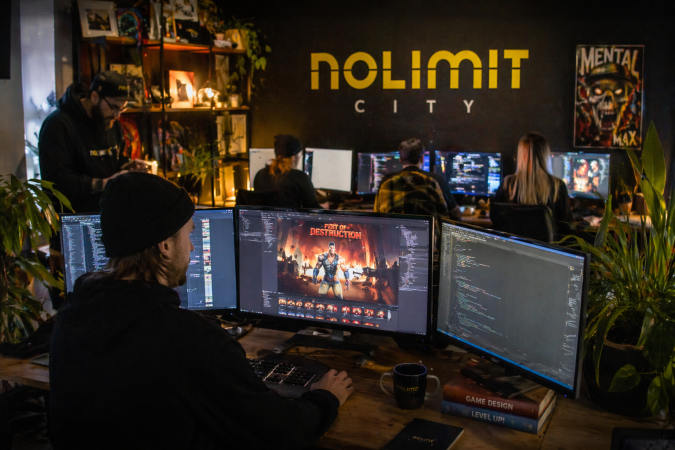
The studio was founded in 2013, launched its first game in 2016, and built its name by going in the exact direction most providers avoid. Even after Evolution bought it in 2022, the identity stayed rough, dark, and very obviously its own.
That is why it feels closer to an indie studio than a normal slot supplier. Not because it makes “video game” slots, but because it takes creative risks that bigger providers usually smooth out before launch. The themes are stranger, the tone is meaner, and the mechanics often feel like they were built to serve one specific game idea instead of being dropped in from a generic feature box.
The Themes Actually Have Teeth
This is the first thing that separates Nolimit City from most of the market. A lot of slot providers still hide inside the usual safe pile: ancient Egypt, shiny gems, soft mythology, fruit, maybe a pirate if they are feeling rebellious. Nolimit City does not do safe very often. It built major titles around prisons, psychiatric horror, labor camps, grindhouse violence, and ugly humor that clearly is not trying to please everyone.
You can see that clearly in Mental. It is set inside a grim institutional space and leans hard into body-part symbols, patient imagery, and a washed-out medical look. It is not subtle, and that is exactly the point. It feels designed by people who wanted players to react, not just nod politely and keep spinning.
The same goes for San Quentin, which pushes prison violence, foul humor, and a nasty tone so far that you either buy into it immediately or bounce off it completely.
That creative attitude is much closer to indie thinking than slot-factory thinking. An indie studio often survives by having a voice. Nolimit City does the same thing with slots. It would rather be memorable than broadly liked.
The Studio Loves Ugly Math
This is where a lot of players either fall in love with Nolimit City or decide it is not for them.
The games are often brutal. Not fake-brutal. Actually brutal.
- Deadwood xNudge runs at 96.03% RTP with a 13,950x max win and a 1-in-197 free-spin trigger.
- San Quentin xWays sits at 96.03% RTP too, but pushes the max win to 150,000x bet.
- Mental comes in at 96.08% RTP with a 66,666x max win.
- Fire in the Hole 3 goes to 70,000x bet at 96.05% RTP.
That risk profile is part of the brand. These slots are not trying to feel cozy or generous every five spins. They are built around long tension, weird violence, and the idea that a feature can suddenly go nuclear if the chain lines up.
If you want the better-paying end of the catalog rather than guessing title by title, PokieMachine’s guide to high RTP Nolimit City slots is one practical place to start.
The Mechanics Are Not Just Decorative
Plenty of providers invent feature names. Nolimit City built a whole mechanic language around them.
Its trademarked xMechanics now include more than 19 in-house systems, and the studio has become confident enough in them to license those mechanics out to another developer, Sneaky Slots. The list includes names players now recognize straight away: xWays, xNudge, xBomb, xSplit, and newer hits like xGod.
The better part is that the mechanics usually fit the game instead of feeling pasted on.
- In Deadwood xNudge, the whole point is the nudge system. Wild reels do not just land and sit there. They shove upward or downward and build the multiplier as they move.
- In San Quentin xWays, xWays symbols, enhancer cells, and split wilds all push the game toward chaos in a way that actually matches the prison-break tone.
- In Fire in the Hole 3, the mechanics get even more stacked, with xSplit, xBomb, xHole, and xGod all feeding into a 6×6 setup that feels unstable in exactly the way the mine theme wants.
The Games Feel Authored
A lot of slot providers make content. Nolimit City feels like it makes statements.
That does not mean every statement is good. Sometimes the studio pushes too hard. Sometimes the shock value is the point. Sometimes the joke lands with a thud.
But even then, the game still feels authored. You can tell there was an actual opinion behind it. That is rare in slots, where many releases still feel like a committee picked a theme, a color palette, and three bonus features from a spreadsheet.
- Take Mental again. The reason people remember it is not only the RTP or the xWays layout. It is the atmosphere.
- Same with San Quentin. People do not talk about that game because the free spins trigger on three bonus symbols. They talk about it because the whole thing has a nasty, specific identity, from the names of the inmates to the enhancer cells to the ugly prison humor.
- Even Fire in the Hole 3, which is lighter on the shock side, still has a very clear voice. It knows it is a whiskey-soaked mining game with explosives everywhere, and it commits to that without blinking.
That sense of authorship is a huge part of why Nolimit City does not feel like a normal supplier. It feels like a studio with taste, even when that taste is a little unhinged.
It Is Not For Everyone, Which Helps
This sounds backwards, but it matters. Nolimit City works partly because it does not try to win over every player in the room.
A lot of providers flatten themselves chasing “broad appeal”. The result is usually competent and forgettable. Nolimit City does almost the opposite. It leans into high volatility, ugly humor, hard themes, heavy mechanics, and long dry spells that can annoy casual players very quickly. That makes the catalog narrower, but it also makes the fanbase much stronger.
That is another very indie trait. A strong indie studio often knows exactly who it is making things for. It would rather be loved by the right crowd than tolerated by everyone else. Nolimit City has that same energy. You can feel it in the pacing, the writing, the symbols, even the names.
Why It Still Stands Out
The easiest answer is that Nolimit City still feels risky in a business that usually hates risk.
It has history now, proper infrastructure, and Evolution behind it, so this is not some tiny underdog making strange games in a garage.
But the studio still behaves like a team that would rather release one nasty, specific, high-impact slot than five forgettable ones. Its mechanics are recognizable, its themes are harsher than the market average, and its better games still feel like somebody had a strong idea before they had a product plan.
